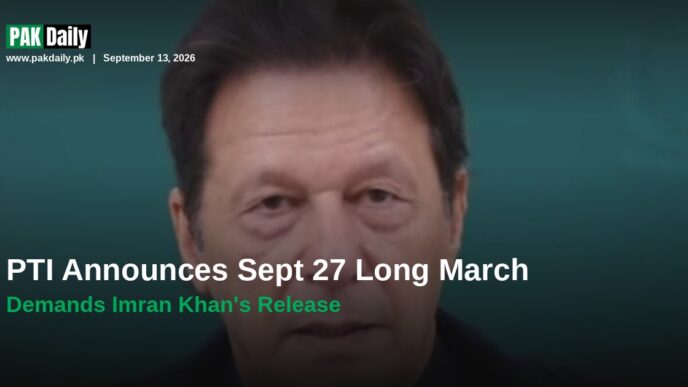


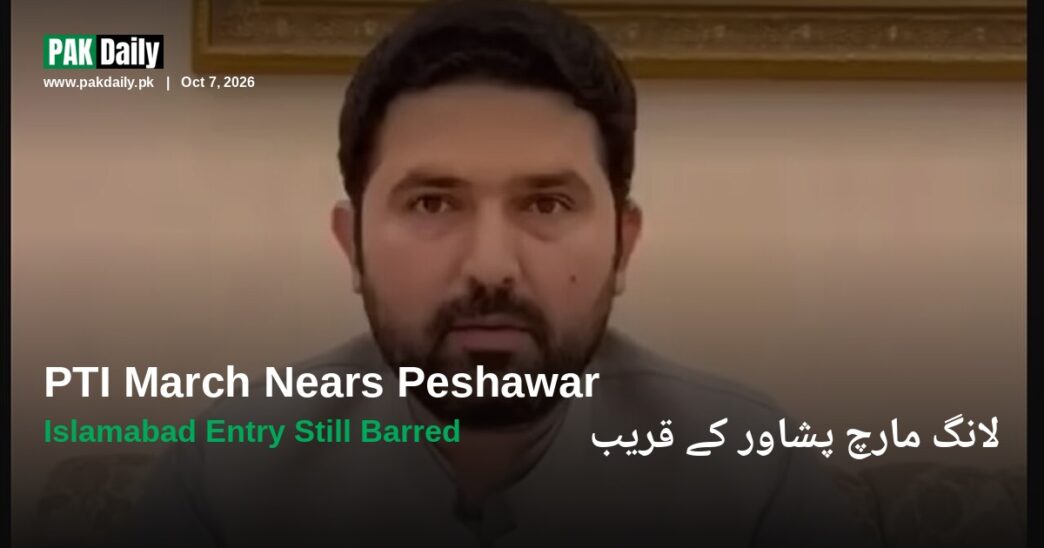
The Pakistan Tehreek-e-Insaf (PTI) long march toward Islamabad entered its fourth day on Wednesday, with Khyber Pakhtunkhwa Chief Minister Sohail Afridi’s convoy pushing out of Mattani on the outskirts of Peshawar after camping there overnight. The federal government has again ruled out letting the march enter the capital, even as Prime Minister Shehbaz Sharif renewed an offer of talks — on the condition that PTI calls off the protest first.
The march, demanding the release of jailed PTI founder Imran Khan, has moved through Khyber Pakhtunkhwa in stages since it set off from Gandi Chowk in Lakki Marwat:
- Oct 4: Convoy departs Lakki Marwat, joined by caravans from Tank, Dera Ismail Khan, North and South Waziristan, and Bannu.
- Oct 4-5: Convoy moves on to Karak.
- Oct 6: Procession advances from Karak to Kohat, then camps overnight in Mattani, just outside Peshawar.
- Oct 7: Convoy leaves Mattani for Khyber at 2pm, heading into Peshawar.
- Oct 8 (planned): March to continue from Peshawar through Charsadda to Khairabad, on the KP-Punjab border.
CM Afridi has framed the march around seven demands centred on Imran Khan — including access to proper medical treatment, in-person meetings with family and lawyers, and his release through due legal process — after what PTI describes as repeated failed attempts to secure court-ordered meetings. Section 144 has been imposed across several KP districts along the route, and the federal government has said the march will not be permitted to enter Islamabad.
“No power would be able to stop” the march to Islamabad, CM Afridi said, adding: “If even one demand is proved to be unconstitutional or unlawful, I will cancel the long march immediately.”
Afridi also held Prime Minister Shehbaz Sharif and jail administration officials directly responsible for Imran Khan’s safety, citing concern over his health in custody. KP Governor Faisal Karim Kundi pushed back on the march’s scale, telling reporters the convoy “cannot go any further than Attock” and challenging PTI’s claims of mass turnout: “They claim to have two million people — show us the people.”
On Wednesday, PM Shehbaz reiterated that talks with PTI depend on the march ending first, warning that continued protests were hurting exports, manufacturing and imports. “End your long march and protests. When you end them, we will surely sit down with you,” he said, adding that “the law will take its course.” Interior Minister Talal Chaudhry said “constitutional options are under discussion,” a reference to reports that the centre is again weighing governor’s rule in Khyber Pakhtunkhwa if the march continues toward the capital.
Our Opinion
What stands out in this standoff is how familiar it feels — a provincial government leading a march on the capital, a federal government conditioning dialogue on the protest ending first, and the spectre of governor’s rule being raised as leverage rather than used as a last resort; none of this suggests either side has learned much from the last decade’s long marches, which rarely changed the underlying political arithmetic even when they dominated headlines for weeks. The more consequential question — whether Imran Khan is actually receiving adequate medical care and legal access in custody — keeps getting folded into the louder argument over marches and governor’s rule, and it deserves to be examined on its own terms rather than as a bargaining chip for either side.