
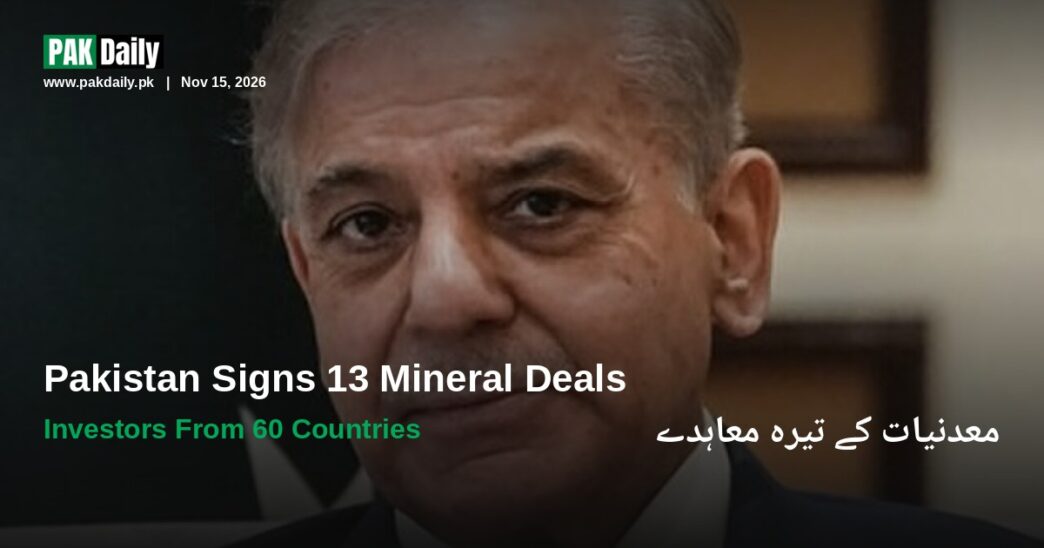
Pakistan’s two-day Minerals Investment Forum (PMIF26) wrapped up in Islamabad on Friday, November 13, with 13 agreements, memoranda of understanding and joint ventures signed between Pakistani and foreign firms, as Prime Minister Shehbaz Sharif pushed delegates from roughly 60 countries to go beyond digging up raw ore and instead build mines, processing plants and factories on Pakistani soil, according to Dawn and The Express Tribune.
The push comes against a striking backdrop: the Institute of Cost and Management Accountants (ICMA), cited by the Tribune, estimates Pakistan is sitting on mineral reserves worth roughly $8 trillion spread across some 600,000 square kilometres, yet mining has historically contributed less than 3 percent to GDP. With stronger governance and security, ICMA reckons annual mineral exports could climb from about $3 billion to $8 billion, lifting GDP growth from around 3 percent to 6 percent.
“Mine in Pakistan, process in Pakistan, manufacture in Pakistan and then export to the rest of the world,” PM Shehbaz Sharif told the forum, according to Dawn.
Sharif also told nervous investors that security would not be an issue, saying “your safety is our safety,” and promised to personally clear away red tape: “If any file gets stuck due to bureaucratic delays or cumbersome procedures, bring it straight to me,” he said, adding he would make sure it “moves at lightning speed.” He pointed to Goldman Sachs projections that Pakistan could become the world’s sixth-largest economy by 2075, saying he hoped the country would get there even sooner, before 2050.
Chief of Defence Forces/Army Chief Field Marshal Asim Munir, who also addressed the forum, said security arrangements now covered mines, workers, investors and associated projects, and urged the sector to move “from potential to production, from promises to action, and from raw exports to value-added growth,” per Dawn’s report.
Both outlets put the signed-deal count at 13, though they describe slightly different line-ups of agreements; the table below lists the partnerships both papers corroborated.
| Partners | Deal / Focus Area |
|---|---|
| Lidiya Mining (Turkiye) & Mari Minerals | Joint venture for exploration and development in Chagai, Balochistan |
| MSALABS (UK) & Mari Minerals | JV to set up a commercial mineral assay lab in Pakistan |
| MTA International Company (Turkiye) & Mari Minerals | Strategic framework for copper and gold exploration in Chagai |
| Ivanhoe Atlantic & Mari Minerals | Copper and gold exploration partnership in Chagai |
| Frontier Works Organisation & Ivanhoe Mines | MoU for joint exploration and mining in Chagai |
| Pakistan & Japan | Statement of intent to support the Geological Survey of Pakistan (GSP) |
| GSP & Turkiye’s MTA, Germany’s BGR, British Geological Survey | MoUs on geosciences cooperation |
| MTAIC (Turkiye) & PMDC | JV for antimony, copper, gold, silver and molybdenum in Pishin, Balochistan |
| International Geosciences Services & PMDC | JV for gemstone resource assessment |
| Fleet Space & others | Ambient noise tomography and airborne geophysical survey agreements |
Petroleum Minister Ali Pervaiz Malik said exploration was now being steered toward strategically important deposits: copper and gold in Chagai and western Balochistan, lithium, tin and tungsten in Gilgit-Baltistan, and antimony and base metals in Khyber Pakhtunkhwa, alongside copper-smelting plans and 1:50,000-scale geological mapping by the GSP. He also cited planned upgrades to the Rohri-Nokundi railway and connectivity to Port Qasim to support the sector.
The forum leaned heavily on the Reko Diq copper-gold project in Balochistan, in which Barrick Mining owns a 50 percent stake, as the template investors should follow. Sharif said production at Reko Diq was expected to begin in 2028, after the project sat stalled for roughly two decades, and called for refineries, smelters and cable factories to spring up along the same mineral-rich Tethyan belt. Barrick’s executive chairman, John Thornton, told the forum the company “intends to continue to be a long-term partner of Pakistan,” according to the Tribune, while in a separate meeting with Sharif, Barrick officials discussed investing in processing facilities in Karachi and Gwadar. Separately, the Frontier Works Organisation estimates roughly 350 million tonnes of copper in the Dasht-i-Kain area of Chagai, based on about half of its drilling data so far, Dawn reported.
Our Opinion
A roomful of signed MoUs is a genuinely useful signal of investor interest, and Pakistan’s $8 trillion reserve estimate is real enough to justify the attention; but this country has heard big mining promises before, and Reko Diq itself is the cautionary tale sitting right inside the PM’s own speech — a project that took roughly twenty years to go from discovery to a firm production date. The gap between an MoU and an operating mine is where Pakistan’s governance, security and regulatory consistency will actually be tested, not at a forum stage in Islamabad; until spades are in the ground at Chagai and Pishin, the 13 agreements are best read as a promising start rather than a transformation already underway.