


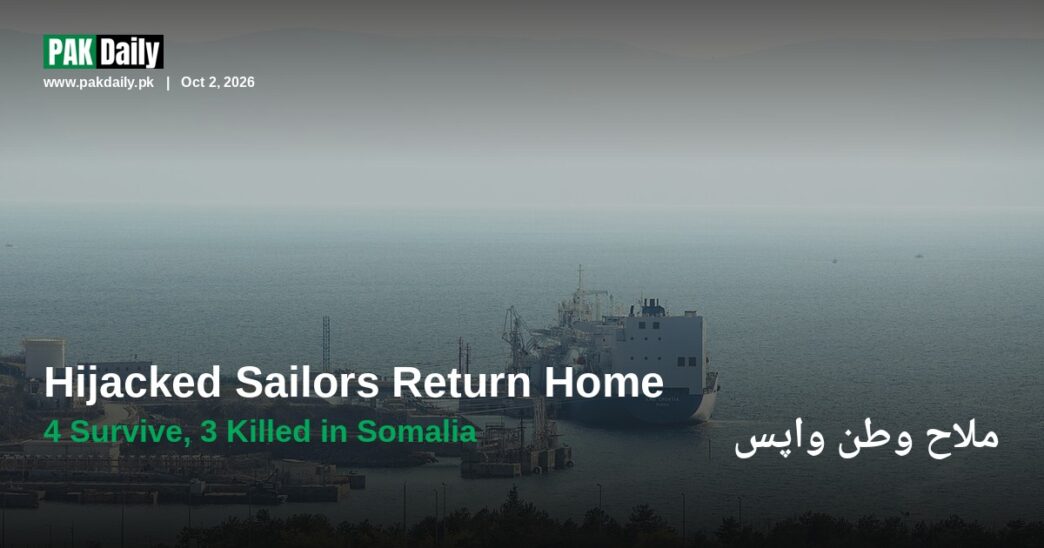
Four Pakistani sailors who survived a months-long piracy ordeal off the coast of Somalia are set to arrive home in Karachi on Saturday, Deputy Prime Minister and Foreign Minister Ishaq Dar announced, even as the remains of three of their crewmates who were killed by their captors are being flown back for burial.
The oil tanker MT Honour 25, a Palau-flagged vessel sailing from Oman toward Somalia’s Puntland region with a cargo of oil, was seized by armed pirates on April 21 roughly 30 nautical miles off Puntland’s coast. Of the 17 crew members aboard at the time, ten were Pakistani nationals. For more than five months, the ship and its crew remained in pirate hands with little public update on their fate.
That changed on September 29, when naval and ground units of the Puntland Maritime Police Force carried out what the force described as a planned operation in the Dharin-Bar area of Bandar Beyla district, freeing the vessel and placing it “under the Puntland government’s control,” according to a statement the force issued and reported by Dawn. The force said the pirates had killed five crew members — three Pakistanis, one Indian and one Myanmar national — before the raid began, and that four others, three Pakistani and one Indian, were wounded.
Announcing the development, Dar said: “Following sustained efforts by the Foreign Office and our Embassy in Djibouti, four of the ten Pakistani crew members have been safely retrieved.”
| Pakistani Crew Member | Role Aboard | Current Status |
|---|---|---|
| Yasir Khan | Crew | Rescued, returning to Karachi Oct 3 |
| Aqeel Khan | Crew | Rescued, returning to Karachi Oct 3 |
| Amin bin Shams | Crew | Rescued, returning to Karachi Oct 3 |
| Usman Ghani | Crew | Rescued, returning to Karachi Oct 3 |
| Rafiullah Khan | Boiler | Killed; remains being repatriated |
| Syed Kashif Umer | Second Officer | Killed; remains being repatriated |
| Mahmood Ahmed Ansari | Third Engineer | Killed; remains being repatriated |
| Imran Ali | Crew | Remains aboard, extraction underway |
| Yasin Muhammad | Crew | Remains aboard, extraction underway |
| Syed Yousuf Hussain | Crew | Remains aboard, extraction underway |
The remaining three Pakistani crew members are still aboard the tanker along with the ship’s captain, and the government says it is working with foreign partners to bring them home as well. “We are actively coordinating with our friendly countries to facilitate their safe extraction and earliest possible return to Pakistan,” Dar said, as reported by The Express Tribune.
On the number of pirates detained in the raid, reports diverge slightly: Dawn and The Nation both put the figure at 21 suspected pirates apprehended, while Geo News reported 16 captured — a modest gap that has not been independently resolved, though the larger, better-corroborated figure of 21 is the one most consistently cited. Puntland authorities said operations to track down any remaining pirates were continuing.
The Foreign Office said a team from Pakistan’s embassy in Djibouti was dispatched to Bandar Beyla to assist the affected nationals, and that “every possible effort is being made to ensure proper medical care for the injured” and to “facilitate the transportation of the mortal remains of the deceased,” with legal and other formalities being fast-tracked. The Ansar Burney Trust, a Pakistani human rights organisation that has been tracking the case, said the International Maritime Organisation had also pledged cooperation in returning the injured crew and the bodies of the dead to their home countries.
The Foreign Office extended condolences to the bereaved families, saying: “The Government and people of Pakistan extend their deepest condolences to the bereaved families.”
Our Opinion
This case is a reminder of how exposed Pakistani seafarers are to risks that get little attention until a tragedy forces the issue into the headlines — it took more than five months, and three deaths, for this hijacking to become a matter of sustained public diplomatic effort, and three more Pakistani sailors are still waiting to come home even now; going forward, the Foreign Office and maritime unions would do well to examine whether faster coordination with regional naval forces, and clearer standing protocols for high-risk shipping routes, could spare families this kind of prolonged uncertainty in the future.