

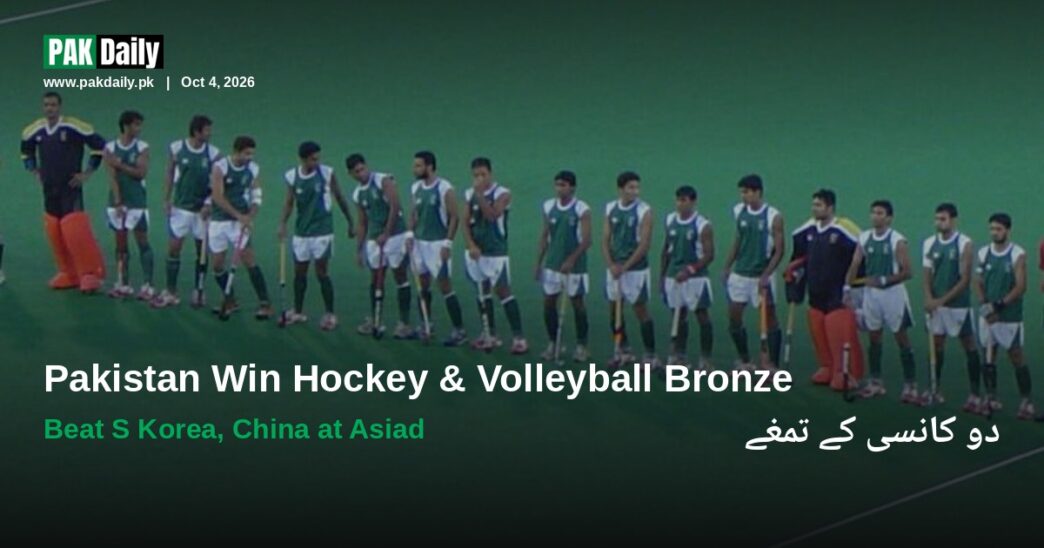
Pakistan had its best single day at the 2026 Asian Games in Japan on Saturday, winning bronze medals in both men’s hockey and men’s volleyball within hours of each other — ending a 12-year wait for a hockey medal and a 64-year wait for a volleyball one.
In hockey, Pakistan beat South Korea 5-3 in a dramatic comeback at the Gifu Prefectural Green Stadium in Aichi-Nagoya, having trailed 1-3 early in the second quarter. In volleyball, Pakistan swept China 3-0 at the same Games to claim only the country’s second-ever Asian Games medal in the sport, and its first since 1962.
Hockey: Pakistan Fight Back From 1-3 Down to Beat South Korea 5-3
Sufyan Khan put Pakistan ahead inside the fourth minute with a penalty-corner conversion, but South Korea hit back through Lee Gang-san (12′), Kim Jung-bok (18′) and Yang Ji-hun (25′) to lead 3-1. Abdul Rehman pulled one back from a penalty corner in the 30th minute to make it 2-3, and the sides stayed that way until the final quarter, when Rana Waheed scored twice in quick succession — in the 52nd and 54th minutes, the second also from a penalty corner — to put Pakistan 4-3 up. Hannan Shahid added a fifth goal in the 59th minute to confirm the win, according to a report by the state-run Associated Press of Pakistan (APP).
It is Pakistan’s first Asian Games hockey medal since a silver in 2014, according to APP, ending a 12-year medal drought in a sport the country once dominated with three Asian Games golds in the 1990s and 2010.
“The team’s performance will provide further impetus to the revival and development of hockey in Pakistan and enable the players to continue bringing honour to the country,” said Pakistan Hockey Federation president Muhyuddin Ahmad Wani, as quoted by APP.
Pakistan had opened their campaign at this year’s Games with a 9-0 rout of Thailand.
Volleyball: Pakistan Sweep China to End 64-Year Wait
Hours later, Pakistan’s men’s volleyball team beat China 3-0 (25-18, 25-16, 25-18) in Nagoya to claim bronze — the country’s first Asian Games volleyball medal since a bronze at the 1962 Jakarta Games, according to The Express Tribune. Opposite hitter Murad Khan top-scored for Pakistan with 18 points, with outside hitters Afaq Khan and Ali Usman Faryad each adding 14.
The match, which lasted just over an hour, was lopsided on the stat sheet: Pakistan converted 46 of 72 attacking attempts (64 percent) against China’s 27 of 70 (39 percent), and out-blocked their opponents 13-2, the Tribune reported.
Pakistan reached the bronze-medal match after beating Kazakhstan and Uzbekistan in their group, then knocking out India 3-0 in the quarter-finals before losing to three-time defending champions Iran in the semi-final.
| Sport | Result | Opponent Beaten | Medal | Last Pakistan Medal in Event |
|---|---|---|---|---|
| Hockey | Won 5-3 (trailed 1-3) | South Korea | Bronze | 2014 (Silver) |
| Volleyball | Won 3-0 (25-18, 25-16, 25-18) | China | Bronze | 1962 (Bronze) |
- Rana Waheed’s two penalty-corner goals in the space of two minutes turned the hockey match around after Pakistan had trailed for most of the first half.
- Hannan Shahid’s late strike in the 59th minute sealed the hockey win with barely a minute of regulation time left.
- Murad Khan’s 18-point haul, spread evenly across all three volleyball sets, was the standout individual performance of the bronze-medal match.
- Pakistan’s volleyball side out-blocked China 13-2, a key factor behind the straight-sets scoreline.
Our Opinion
Two bronze medals on the same day, in two sports that had gone a combined 76 years without an Asian Games podium finish between them, is a result worth celebrating on its own terms — but it should also prompt an honest conversation about why these droughts were allowed to run so long in the first place; Pakistan hockey in particular was once a continental powerhouse, and a single bronze, however hard-fought, is a starting point for rebuilding rather than proof that the structural issues in domestic sports funding and development pipelines have been fixed. The credit for Saturday belongs to the players and coaches who delivered under pressure; what happens next, in terms of sustained investment from the relevant federations, is what will determine whether this is a turning point or a one-off.