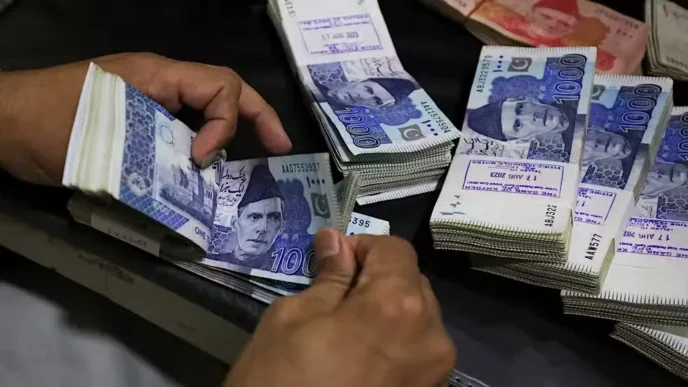

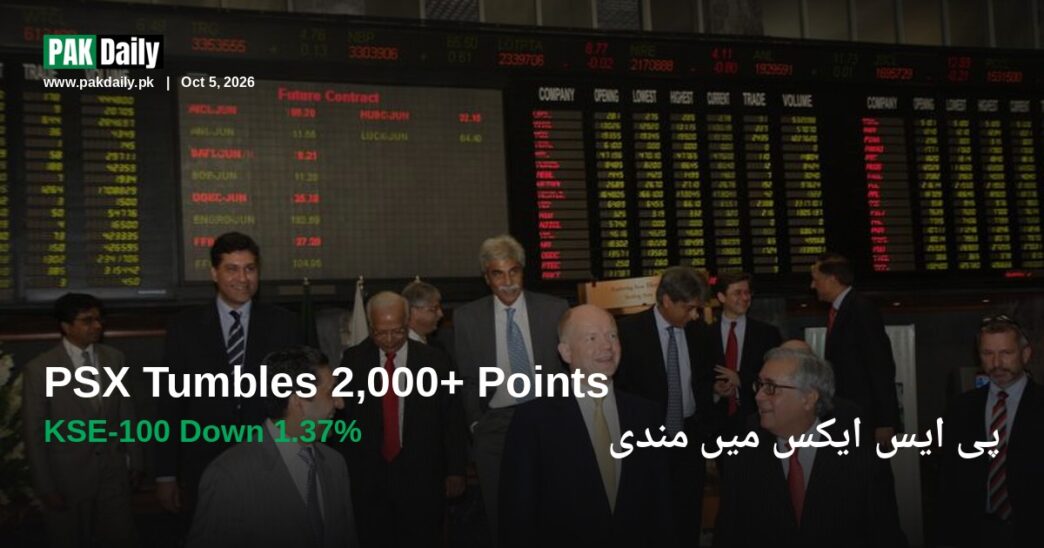
The Pakistan Stock Exchange’s benchmark KSE-100 index tumbled more than 2,000 points in Monday trading, as investors reacted to the collapse of a second round of government-opposition talks and persistently high international oil prices. By mid-afternoon, the index had fallen as much as 2,295.5 points, or 1.37 percent, to around 165,860 — down from Friday’s close of 168,155.49 — according to Business Recorder’s intraday market tracker. The Express Tribune, tracking the session roughly 15 minutes earlier, put the decline at close to 2,000 points to 166,278.52, a reading consistent with the index continuing to slide through the day rather than any disagreement between the two outlets.
| Index | Previous Close | Monday (intraday) | Change |
|---|---|---|---|
| KSE-100 | 168,155.49 | ~165,860 | -2,295.5 (-1.37%) |
| BR100 | — | 18,178 | -318.7 (-1.72%) |
| BR30 | — | 64,522 | -1,779.1 (-2.68%) |
| KSE30 | — | 49,481 | -671.1 (-1.34%) |
Selling pressure was broad-based, hitting automobile assemblers, cement makers, commercial banks, oil and gas exploration firms, oil marketing companies, power generation stocks and refineries. Heavyweight names trading in the red through the session included Pakistan Refinery (PRL), National Refinery (NRL), Hub Power (HUBCO), Mari Petroleum (MARI), Oil and Gas Development Company (OGDC), Pakistan Petroleum (PPL), Habib Bank (HBL), Meezan Bank (MEBL), National Bank of Pakistan (NBP) and United Bank (UBL), Business Recorder reported. Smaller-cap names saw sharper swings, with NBP down 3.16 percent, TPL Properties down 6.76 percent, Pak International Bulk Terminal (PIBTL) down 5.77 percent, and Pace (Pakistan) down 5.15 percent.
“Local political uncertainty, coupled with elevated oil prices, is weighing on investor sentiment and driving selling pressure” across the market, analysts told Business Recorder.
The immediate trigger was political rather than economic. A second round of talks between the federal government and opposition parties — aimed at averting PTI’s planned march on Islamabad — broke down late Saturday, Dawn reported. The government delegation, led by Interior Minister Mohsin Naqvi along with Minister of State Tallal Chaudhry, Amir Muqam and Rana Sanaullah, met opposition figures including Senate Opposition Leader Allama Raja Nasir Abbas and PTI’s Barrister Gohar Khan and Salman Akram Raja. Two issues proved unresolvable: the opposition’s demand that jailed PTI founder Imran Khan be allowed to meet his personal physicians and his wife Bushra Bibi, which the government resisted formalising in any agreement, and Islamabad’s insistence that the PTI-led Khyber Pakhtunkhwa government commit to the National Action Plan on counter-terrorism — something officials said KP “could not assure” cooperation on. “Deadlock,” was how Allama Raja Nasir Abbas summed up the talks, while Gohar Khan said PTI’s march would go ahead regardless.
That political impasse landed on a market already nursing elevated energy costs; Brent crude has stayed above $100 a barrel in recent sessions, a level that typically squeezes Pakistan’s import bill and widens its trade deficit, adding a second layer of pressure on top of the political overhang. The combination reversed a much calmer mood just weeks earlier — the KSE-100 had in fact rallied 1,841 points to close at 170,884 in mid-September, before a run of political and external shocks chipped away at those gains.
Our Opinion
Monday’s selloff is a reminder that Pakistan’s stock market has become, in effect, a running referendum on the state of talks between the government and PTI — a dynamic that leaves investors exposed to a negotiating table they have no seat at and little visibility into; whatever one’s view of the underlying dispute over Imran Khan’s access to his lawyers and family or the government’s counter-terrorism demands on KP, an economy still working through IMF-linked reforms can ill afford a political standoff that doubles as a market shock every few weeks, and the more durable fix lies in both sides finding a way to disagree without routinely spooking the bourse.