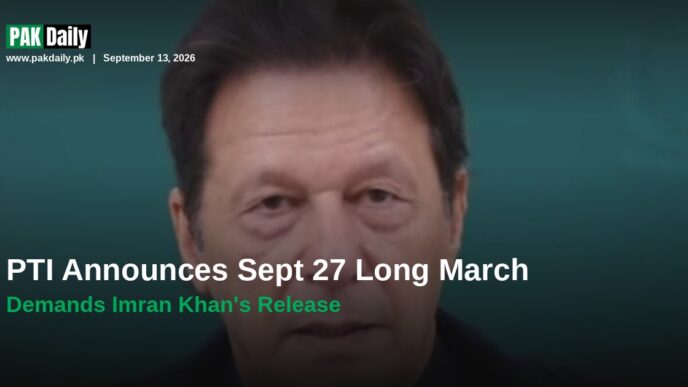

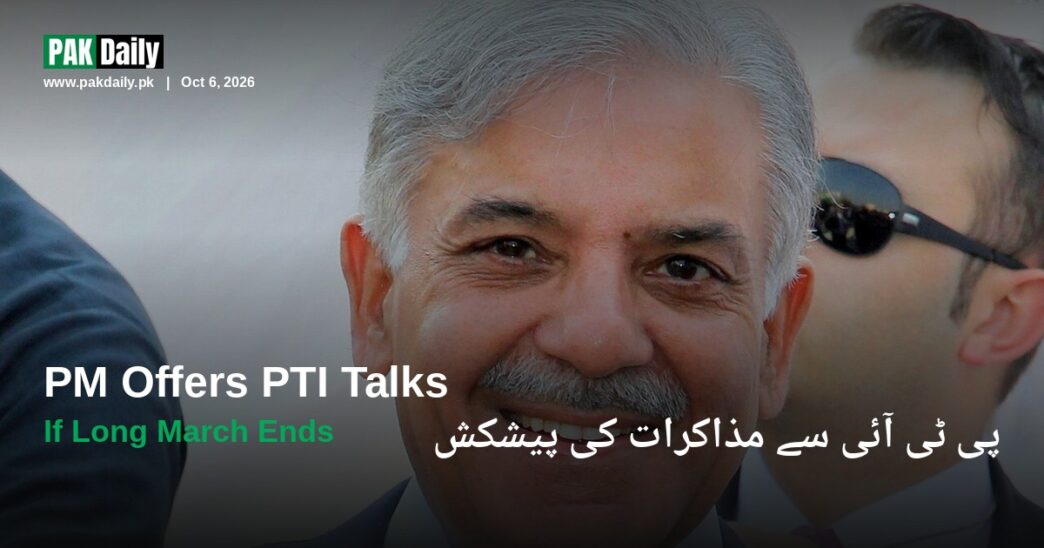
Prime Minister Shehbaz Sharif said on Tuesday that the government is ready to resume talks with the Pakistan Tehreek-e-Insaf (PTI) only if the party calls off its ongoing long march and sit-ins, as the opposition’s convoy pushed out of Khyber Pakhtunkhwa (KP) toward Islamabad demanding the release of its founder, Imran Khan.
“End your long march. If you end it, then we will certainly sit with you and talk,” the prime minister said at the groundbreaking of the Kashmir Chowk Underpass in Islamabad, according to Dawn, pressing PTI to end the protest launched from Kohat on Sunday. Questioning the opposition’s priorities, he asked, “Do you want to damage this? Do you want to harm Pakistan’s progress?” and said protecting citizens’ lives “is our duty and we will ensure it.”
The prime minister also referred to an earlier round of talks held in the National Assembly speaker’s chamber, saying negotiations collapsed when the opposition sought last-minute changes to the terms — a breakdown he framed as evidence PTI was not negotiating in good faith. He cited rising September exports, IT exports and remittances as reasons the country could ill afford fresh political disruption.
“They cannot go any further than Attock… show us the people; they don’t have the capacity,” said KP Governor Faisal Karim Kundi, questioning whether PTI could muster the two million supporters it claims.
Kundi’s warning, reported by Dawn, followed a meeting with Interior Minister Mohsin Naqvi and builds on an earlier threat to impose governor’s rule in KP ahead of this same march. He also questioned what screening mechanism PTI has in place to stop militant infiltration from southern KP, and alleged KP Chief Minister Sohail Afridi was taking “directions from PTI leader Murad Saeed.”
Separately, Minister of State for Interior Talal Chaudhry told reporters in Islamabad that the prime minister had directed officials to “give as much political space as can be given” to PTI — but only in exchange for the party’s full cooperation on counterterrorism. “We value Pakistan’s security, the elimination of terrorism; even if the opposition is given political mileage,” Talal quoted the premier as saying, according to the Express Tribune, tying any political concession to full compliance with the National Action Plan in KP.
Punjab’s Home Department, meanwhile, extended its ban on public gatherings for another 10 days, from October 6 to October 15, under Section 144 of the Code of Criminal Procedure. The notification covers assemblies, processions and gatherings of five or more people, as well as carrying or displaying weapons in public, and cites “credible reports” of threats from terrorist organisations and hostile intelligence agencies — including warnings of suicide bombers, vehicle-borne explosives and target killings at large public gatherings. Marriages, funerals, prayers and court proceedings remain exempt; it is the second such extension in the province since an earlier 13-day restriction expired on October 5.
Tuesday’s developments came in quick succession:
- Oct 4 (Sunday): PTI’s long march sets off from Kohat, KP, demanding Imran Khan’s release.
- Oct 6 (Tuesday): PM Shehbaz offers conditional talks if PTI ends the march and sit-ins.
- Oct 6 (Tuesday): Minister Talal Chaudhry says the offer is tied to full counterterrorism cooperation from PTI and the KP government.
- Oct 6 (Tuesday): Punjab extends its Section 144 gathering ban for 10 more days, through October 15.
- Oct 6 (Tuesday): KP Governor Kundi warns the march will not be allowed past Attock.
- Oct 8 (expected): KP Chief Minister Sohail Afridi’s convoy is due to reach Khairabad, on the KP-Punjab border, before announcing its next move.
Our Opinion
This is at least the second time in recent weeks that an offer of dialogue and a hardened security posture have arrived in the same breath, and that pattern is worth noting on its own terms: a government that says it wants talks while simultaneously extending emergency gathering bans and warning a provincial convoy it will be physically stopped is sending two signals at once, and it is marchers, bystanders and markets who are left to guess which one actually holds. Pakistan’s political institutions have leaned on this same interim toolkit — Section 144 notifications, provincial stand-offs, talks that collapse over last-minute terms — often enough that the exceptional has started to look routine; if the offer of dialogue is to be taken as genuine rather than tactical, it will need to survive contact with the next deadline better than the last round did, by the prime minister’s own account.