
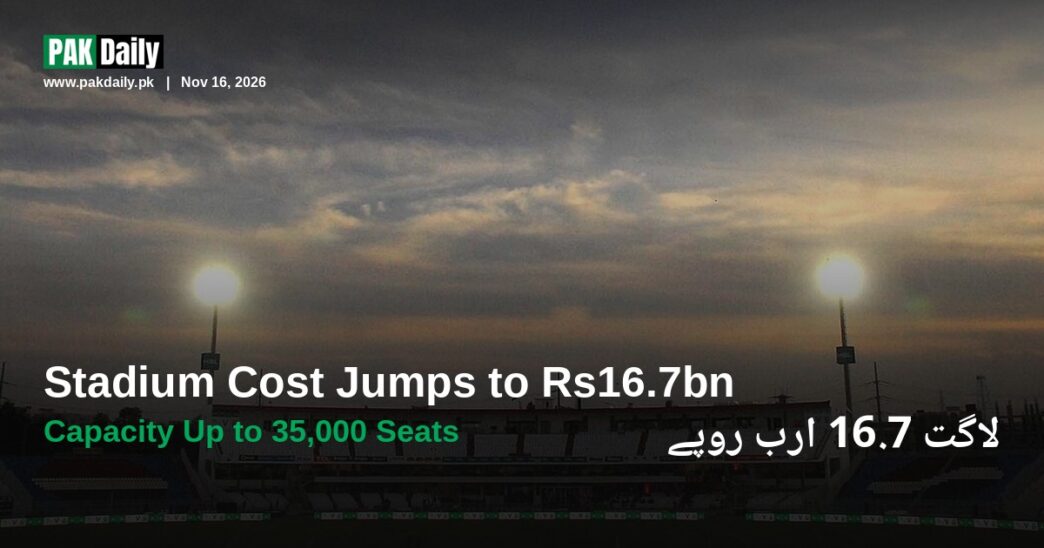
The Capital Development Authority (CDA) has finalised a revised cost estimate for Islamabad’s long-planned cricket stadium, pushing the project’s budget to Rs16.7 billion — a jump of roughly 40 percent over the Rs11.9 billion figure the authority had been working with earlier this year, Dawn reported on Monday.
A CDA officer told the paper that the increase reflects a longer list of components added to the project since construction bids were invited, including the stadium’s grey structure, finishing and electrical work, lighting, heating and air-conditioning, ground and pitch preparation, and a security camera system. Seating capacity has also been raised to around 35,000 from the 25,000 envisaged in the original concept — a change officials said followed requests for proposals invited from construction firms earlier this year.
The venue, being built at the foothills of the Margalla Hills near Sector D-12, is designed as a three-tier structure modelled on Dubai’s International Cricket Stadium, according to CDA officials cited by Dawn. If completed as planned, it would become Pakistan’s largest cricket stadium by capacity. The site falls in Zone III, where new construction is generally restricted under Islamabad’s master plan, but the CDA maintains that cricket stadiums are a permitted use within the zone.
How the Cost Estimate Has Moved
Reports on the project’s price tag have shifted several times over the past year, and the figures don’t all reconcile cleanly with one another:
| Stage | Reported Cost | When Reported |
|---|---|---|
| Revised concept-stage PC-I (reduced from an original Rs12bn estimate) | Rs8 billion | December 2025 |
| PC-I figure cited as bids were evaluated | Rs11.9 billion | July 2026 |
| Winning construction bid (Habib-ZKB-EA JV, before rebate) | Rs8.9 billion | July 2026 |
| Contract value after a Rs400m rebate | Rs8.5 billion | July 2026 |
| Revised, finalised PC-I | Rs16.7 billion | November 2026 |
Measured against the Rs11.9 billion figure that was in use as recently as July, Monday’s revision marks an increase of about 40 percent. Measured against the Rs8 billion figure reported last December, it is more than double. Dawn’s report does not explain the gap between the December 2025 and July 2026 figures, and neither of the earlier reports mentions the other’s number — so it isn’t clear which baseline the CDA itself now regards as the project’s original estimate.
CDA officials said Phase-I of the project, covering the grey structure, is expected to be completed within six months of groundbreaking, which Dawn reported would be “held soon.” The authority is aiming to finish both phases within a year of construction starting. Interior Minister Mohsin Naqvi had earlier said groundbreaking would take place within 10 days of his announcement on the project; officials told Dawn that the PC-I revision was not the cause of the delay beyond that original timeline.
A Pakistan Cricket Board official was quoted as saying Islamabad could host some matches of the ICC Women’s T20 World Cup 2028 if the stadium is completed on schedule. The project marks the CDA’s second attempt at building a dedicated cricket venue in the capital after an earlier PCB-led stadium plan at Shakarparian was shelved following Supreme Court directions; this time, the CDA itself is leading construction rather than the cricket board.
Our Opinion
Cost estimates on Pakistani public infrastructure projects have a well-worn habit of climbing well past their original pitch, and this stadium’s paper trail — from a reported Rs8 billion last December to Rs11.9 billion by mid-2026 and now Rs16.7 billion — fits that pattern a little too neatly to be reassuring; a bigger stadium with more amenities is a reasonable explanation for some of the increase, but taxpayers and cricket fans alike would be better served by a single, consistently reported baseline figure from the CDA rather than a moving target that only gets explained after each upward revision, and what matters now is whether the project can stay on the one-year timeline officials are promising without another round of cost creep.