
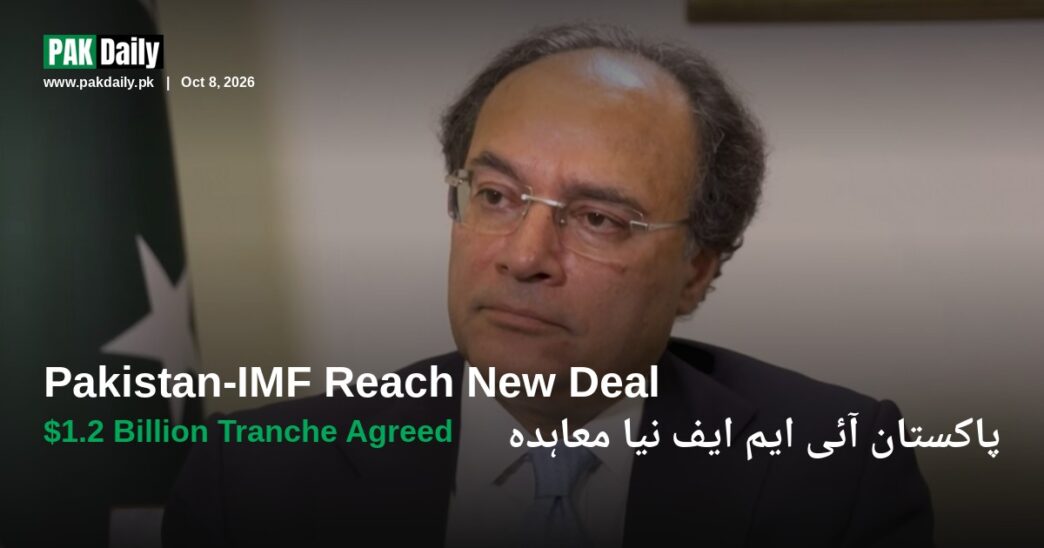
Pakistan and the International Monetary Fund have reached a staff-level agreement that clears the way for the country to draw roughly $1.2 billion in fresh financing, the Fund said on Wednesday. The deal follows the fourth review of Pakistan’s 37-month, $7 billion Extended Fund Facility (EFF) and the third review of its 28-month Resilience and Sustainability Facility (RSF), after an IMF mission led by Iva Petrova spent two weeks in Karachi and Islamabad, according to Dawn and The Express Tribune.
The agreement still needs sign-off from the IMF’s Executive Board, which is expected within four to five weeks, before the money is actually disbursed. Once approved, it would take Pakistan’s cumulative drawdown under the two arrangements to about $5.7 billion since the EFF was first agreed in July 2024. This is also the point where the Fund wrapped up its 2026 Article IV consultation, a broader annual health-check of Pakistan’s economy that runs alongside the lending programme.
| Facility | Review | This Tranche | Cumulative Disbursed (after approval) |
|---|---|---|---|
| Extended Fund Facility (EFF) | 4th review | ~$1.0bn (SDR 760m) | ~$5.7bn combined |
| Resilience and Sustainability Facility (RSF) | 3rd review | ~$210m (SDR 154m) | |
| Total this tranche | — | ~$1.2bn | — |
Finance Minister Muhammad Aurangzeb held a wrap-up session with Petrova, joined by Finance Secretary Imdad Ullah Bosal and the IMF’s Resident Representative in Pakistan, Mahir Binici, the Finance Ministry said. The Fund credited Islamabad with holding the economy steady through a difficult year, noting that the authorities had “successfully navigated the impact of the Middle East conflict” even as regional risks stayed elevated.
On the numbers, the IMF team found Pakistan’s economy in reasonably good shape: real GDP grew 4% in the first three quarters of FY26, with the full-year estimate put at 3.6%, while headline inflation has eased to about 10.3% in September after peaking in May. The current account was broadly balanced over FY26, helped by steady remittance inflows, and gross reserves had climbed to roughly $21.5 billion by the end of September.
Much of the hard bargaining, though, centred on Prime Minister Shehbaz Sharif’s fuel relief scheme — a three-month, Rs75 billion package that compensates motorcyclists Rs100 per litre on up to 20 litres a month and owners of cars up to 800cc on up to 30 litres a month. PakDaily reported on the scheme when it was first announced in September. The IMF has pushed back on it as too costly and too broadly targeted, and the Fund said Sharif personally lobbied IMF Managing Director Kristalina Georgieva to keep it in place but did not succeed.
“Any future fuel support, if oil prices rise unexpectedly, should be limited, time-bound, and targeted through established social assistance programmes, and must fit within the FY27 budget envelope,” the IMF mission said, according to Tribune’s account of Petrova’s remarks.
Beyond the fuel scheme, the staff-level agreement locks in a broader set of commitments the government will have to keep through the rest of FY27:
- Fiscal policy: hold the FY27 budget to an underlying primary surplus of 2% of GDP, with risk-based tax audits, digital invoicing, and a medium-term tax reform strategy.
- Monetary policy: keep the State Bank of Pakistan’s stance “appropriately tight,” with the exchange rate left to act as a shock absorber and continued reserve accumulation.
- Energy sector: make timely power and gas tariff adjustments to stop circular debt from building up again, and cut unaccounted-for gas losses.
- Social spending: raise health and education spending from 2.5% of GDP in FY26 to 2.8% in FY27.
- Debt management: reduce rollover risk and borrowing costs, and deepen the domestic securities market.
This is the second time this year PakDaily has tracked this particular review cycle — we reported when the talks opened in late September, with the same $1.2 billion figure already on the table as the target outcome. That the two sides landed almost exactly where they started suggests the fuel-scheme dispute, while politically awkward for the government, was never likely to derail the review itself.
Our Opinion
The headline number here is less interesting than what Pakistan had to give up to get it: a popular, visible relief measure for motorcyclists and small car owners, traded away for a $1.2 billion disbursement that mostly just keeps existing obligations serviced rather than funding anything new. That trade-off is the recurring shape of this programme — the government gets breathing room on reserves and the exchange rate, while the IMF keeps tightening the screws on anything that looks like untargeted populism, fuel relief this time, after similar fights over subsidies and tax exemptions in earlier reviews. The macro indicators Islamabad can point to — slower inflation, a steadier current account, reserves above $21 billion — are real and worth acknowledging. But a $5.7 billion cumulative drawdown four reviews into a $7 billion facility also means Pakistan is now fairly deep into a programme it will eventually have to exit, and the harder test of that transition — whether growth and revenue collection can stand on their own once the IMF’s conditions stop doing the disciplining — is still some way off.