
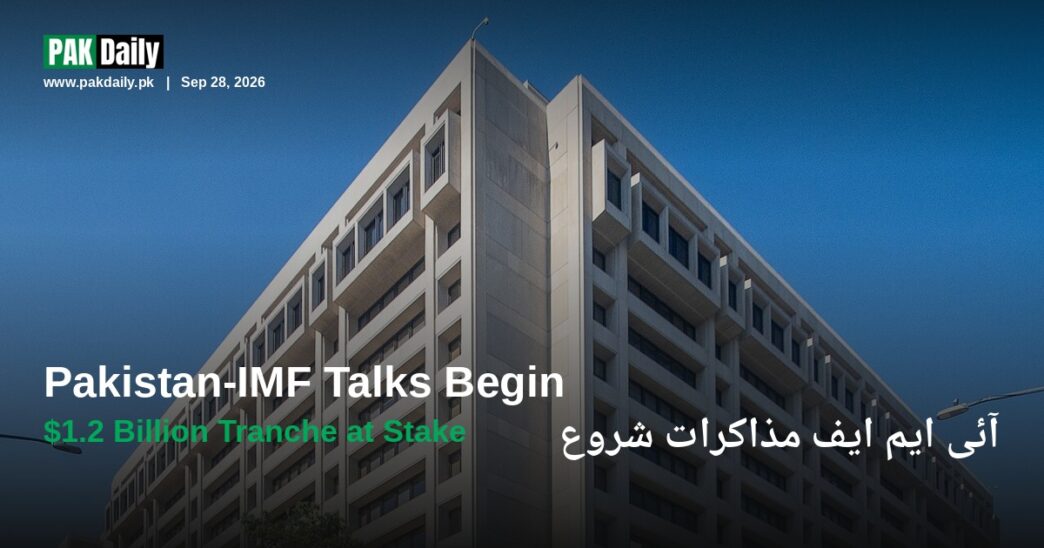
Pakistan and the International Monetary Fund formally began a fresh round of talks in Islamabad on Monday, September 28, aimed at unlocking the next $1.2 billion tranche under the country’s ongoing bailout programme. An IMF staff mission led by Iva Petrova arrived to conduct the fourth review of Pakistan’s 37-month, $7 billion Extended Fund Facility (EFF) alongside the third review of the Resilience and Sustainability Facility (RSF), with talks expected to run into the first week of October.
If both reviews are cleared, Pakistan stands to receive roughly $1 billion (about 760 million Special Drawing Rights) under the EFF and a further $200 million under the RSF, according to Dawn and ProPakistani. Disbursement, contingent on IMF Executive Board approval, is expected by late November or early December.
Finance Minister Muhammad Aurangzeb and Adviser to the Finance Ministry Khurram Schehzad are leading Pakistan’s side of the negotiations. According to Aaj News, the visiting mission opened by reviewing an economic briefing from State Bank of Pakistan officials, with the opening session described as smooth — though the harder bargaining over unresolved reform targets is expected to dominate the coming two weeks.
The review will assess Pakistan’s performance against programme targets using data through June 30, 2026, and covers a wide range of structural and fiscal benchmarks. Key areas under discussion include:
- Progress on reducing the power sector’s circular debt
- Deregulation of the sugar sector, a condition that reportedly remains only partially met
- The size of the fiscal primary surplus and the current account balance
- Foreign exchange reserves levels and exchange rate management
- Expansion of the tax base and FBR revenue-collection reforms, including provincial tax collection
- Progress on the government’s proposed Sovereign Wealth Fund
- Compliance with anti-money-laundering and counter-terror-financing (AML/CFT) standards
Some conditions tied to health and education spending, along with parts of the sugar-sector liberalisation plan, reportedly remain unresolved heading into this round — meaning the two sides could still spend the next fortnight negotiating specific figures rather than simply signing off on an already-settled package.
The government has already leaned on IMF-linked austerity steps this year to keep its fiscal targets on track, including market closure timings and a fuel-quota cut for official vehicles announced earlier this year. Whether this review wraps up smoothly or drags into fresh brinkmanship over the outstanding conditions will shape how much fiscal room the government has heading into its next budget cycle.
Our Opinion
The recurring shape of these reviews — a scramble in the final fortnight to tick off conditions like sugar-sector deregulation or health and education spending that were agreed months earlier — says as much about the state’s implementation capacity as it does about the $1.2 billion at stake; unlocking this tranche will ease near-term pressure, but it does little on its own to explain why the same structural benchmarks keep resurfacing as unfinished business review after review, a pattern worth watching as Pakistan heads into another IMF-shaped budget cycle.