
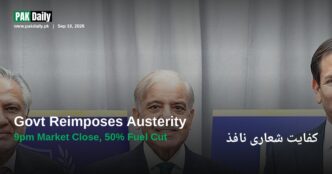
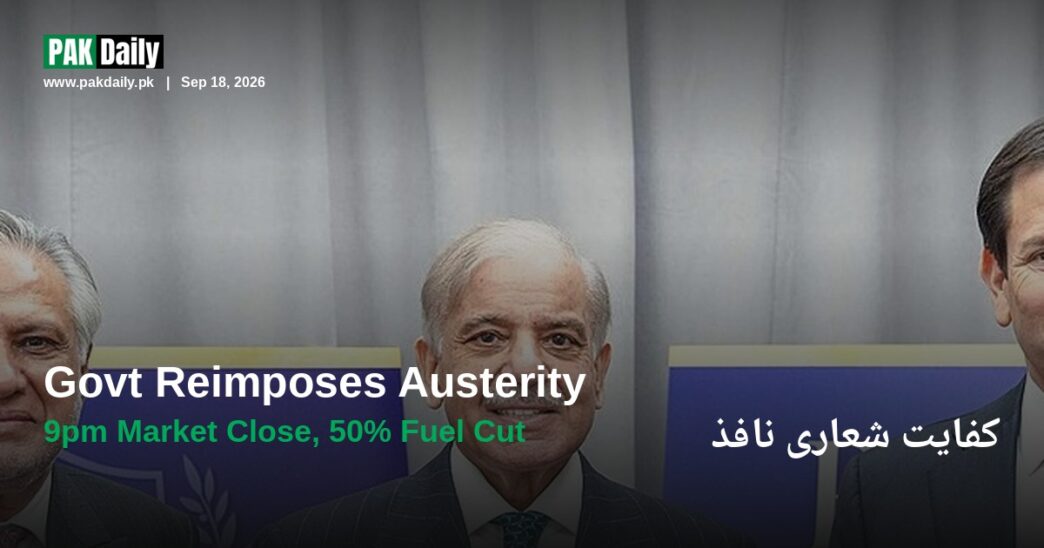
Pakistan’s government has reimposed a sweeping set of austerity measures as international oil prices climb amid renewed Middle East hostilities, with shops and markets now required to close by 9pm and government vehicles facing a 50 percent cut in fuel allocation. The Cabinet Division issued the notification on September 17, and the restrictions took effect immediately, according to Dawn.
The measures come just a day after the government’s petrol relief scheme for motorcycles and rickshaws ran into first-day implementation hurdles, and roughly 48 hours after officials had publicly denied any plan for a “smart lockdown” was under discussion. That denial has now given way to a formal, government-wide austerity notification, even if it stops short of the market-closure and rotating-holiday plan originally floated.
Prime Minister Shehbaz Sharif framed the move as a matter of shared sacrifice, telling officials that “sacrifices should first be made by the government and the elite,” according to The Nation. The government says the renewed restrictions are a direct response to volatility in international energy markets, with petrol and diesel prices rising as Middle East tensions disrupt supply routes through the Strait of Hormuz and Bab al-Mandab — a fresh reminder of the pressure that pushed petrol to Rs391.22 a litre just a day earlier.
“Sacrifices should first be made by the government and the elite,” Prime Minister Shehbaz Sharif said as the austerity package was announced.
What’s Changing, and For How Long
The notification lays out a detailed set of restrictions, most running for three months, with a mix of daily operating-hour limits and broader spending curbs. Dawn and The Nation both confirm the same core package:
| Measure | Detail |
|---|---|
| Government vehicle fuel | Cut by 50% for three months (armed forces, law enforcement, FBR operational vehicles and development projects exempted) |
| Shops, markets, malls | Must close by 9pm |
| Marriage halls / event venues | Must close by 10pm |
| Restaurants and eateries | Must close by 11pm (takeaway/delivery exempt) |
| Wedding functions | Only a single dish permitted at all marriage-related events |
| Foreign travel for officials | Banned for three months, barring scholarships and EAD-arranged training; unavoidable trips must be economy class |
| Vehicle purchases | Complete ban on new government vehicle purchases (development projects excluded) |
| Non-essential budget | 5% cut in non-essential spending for FY2026-27 |
Pharmacies, hospitals, bakeries, fuel stations, gyms and IT companies are exempted from the closure timings, according to Dawn’s report. Provincial authorities have been tasked with enforcing the market and event-venue restrictions locally.
Notably, the government says it will keep running its Rs100-per-litre fuel subsidy scheme for motorcycles, rickshaws and small cars despite the broader belt-tightening, framing the austerity drive as targeted at government spending rather than at relief for low-income commuters.
A Familiar Pattern, With a Twist
Pakistan has turned to similar austerity packages during past energy crunches, and this is not the first time market-hour restrictions and single-dish wedding rules have been floated this year — an earlier, similar proposal was shelved in March after provincial pushback. What’s different this time is the speed of the turnaround: ministers were still denying any lockdown-style plan was on the table as recently as September 16, only for a formal notification to follow within 48 hours.
Some elements of the current package, such as the fuel-allocation cut and foreign travel ban, apply specifically to government departments and officials rather than the general public, distinguishing it from the more sweeping “smart lockdown” concept reported earlier in the week. Still, the market and restaurant closing times will be felt directly by traders and the public, and it remains to be seen how strictly the 9pm rule is enforced in practice, particularly in the run-up to any local pushback of the kind seen in March.
Our Opinion
Pakistan’s governments have reached for the same austerity toolkit — shorter market hours, single-dish weddings, official travel bans — every time global energy prices spike, and while the optics of the PM telling officials to sacrifice first are politically useful, the substance of these measures rarely outlasts the crisis that triggered them; the real test isn’t the notification itself but whether the 50 percent cut in official fuel use and the vehicle-purchase freeze survive contact with ministries that have historically treated such curbs as temporary inconvenience rather than lasting reform, and whether traders and the public accept market-hour restrictions that, as recently as March, were rolled back within weeks of provincial objections.