
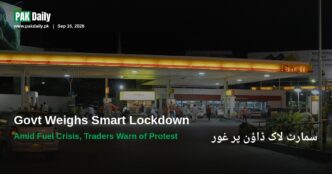
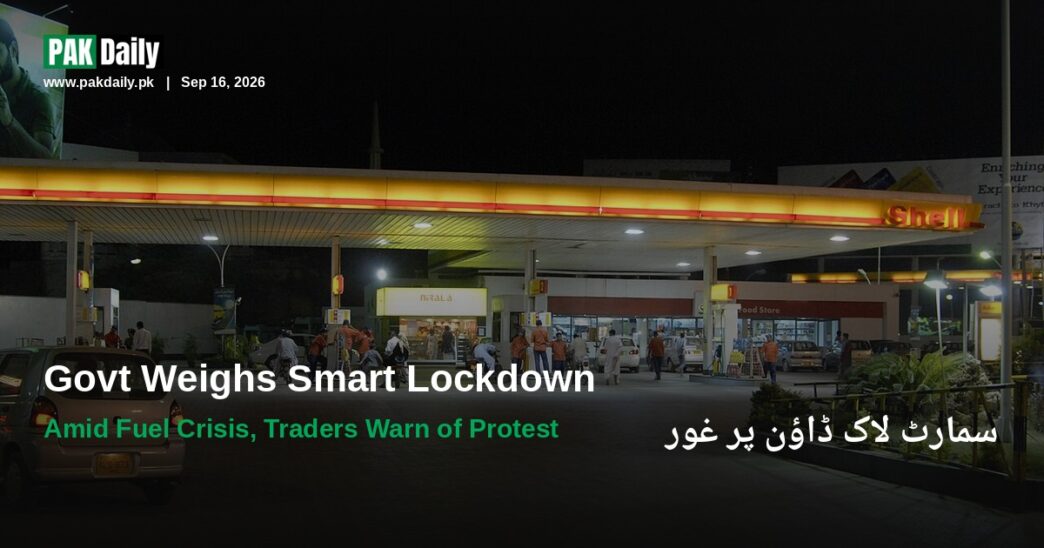
Islamabad is once again weighing a nationwide “smart lockdown” to cut fuel consumption, after petrol and diesel prices were hiked again on September 15 — but two federal ministers have already moved to deny that any final decision has been made, even as traders threaten to take to the streets if the plan goes ahead.
The proposal, reportedly reviewed in detail at a meeting chaired by Prime Minister Shehbaz Sharif, would shift government and private offices to a shortened work week, close markets on a rotating basis for three days a week, and ground roughly half of official government vehicles — all aimed at trimming fuel demand rather than containing any disease outbreak, according to Aaj English, Daily Pakistan and ARY News. It comes just a day after the government raised petrol by Rs4.42/litre and high-speed diesel by Rs6.10/litre, pushing pump prices to roughly Rs380–384 per litre for petrol and Rs409.42 for diesel, with officials citing Brent crude climbing past $108 a barrel amid the wider Middle East supply disruption. Petroleum Minister Ali Pervaiz Malik told Aaj English that “petroleum prices were now being determined on a daily basis due to volatility in the international market.”
Here is how the story has unfolded over the past 48 hours:
- Sept 15 — Prices rise, plan resurfaces: Following the latest fuel price hike, multiple outlets reported that a “petroleum smart lockdown” was back under active review, with a final decision described as expected “that evening.” No such announcement followed.
- Sept 15 (evening) — Islamabad denial: Federal Minister for Parliamentary Affairs Dr Tariq Fazal Chaudhry denied the plan had even been discussed at a meeting chaired by Deputy Prime Minister Ishaq Dar, telling reporters, “Smart lockdown was neither discussed in the meeting chaired by the deputy prime minister nor is it within my knowledge.”
- Sept 16 — Second denial, plan still on the table: Federal Minister Musadik Malik told a press conference in Islamabad there have been “no discussions so far about moving towards a smart lockdown,” saying the government would instead pursue further cost-cutting measures. Yet the same briefings confirm the proposal was in fact reviewed at the PM-chaired meeting — leaving its status publicly denied but not actually withdrawn.
- Sept 16 — Traders threaten protest: Ajmal Baloch, president of the All Pakistan Anjuman-e-Tajiran, the country’s largest traders’ body, rejected the idea outright and warned of street agitation unless the government drops it.
“A lockdown was unacceptable under any circumstances, as the trading community is already facing severe difficulties. If the government wants traders on the streets, it will not take long,” Ajmal Baloch said.
This is not the first time the idea has surfaced this year. A similar plan was drawn up in late March 2026, when petrol crossed Rs321/litre — that version, involving weekend market closures and highway restrictions, was presented by President Asif Ali Zardari to a meeting of all four chief ministers but was shelved after provincial governments objected, with Punjab opting instead to cut its own vehicle purchases and shorten its school week. Whether September’s version meets the same fate remains unclear; alongside the lockdown talk, the government has already pushed ahead with a separate Rs100/litre fuel relief scheme for motorcycles, rickshaws and small cars, rolling out in Islamabad from September 16-17 and nationwide from September 18-19, and Wednesday’s price hike followed the same pattern covered in PakDaily’s September 15 petrol price update.
No opposition party has issued a public statement on the smart lockdown proposal specifically as of this writing.
Our Opinion
The pattern here is becoming familiar: fuel prices spike on an international shock nobody in Islamabad controls, a “smart lockdown” gets floated as a quick fix, and within a day or two it is being denied by the very ministers reportedly briefed on it — a sign that the idea keeps getting tested for public reaction before anyone commits to it politically; the March episode ended in the same way, shelved once the provinces balked, and the traders’ body’s swift threat of street protests suggests the September version may follow the same script unless the government can show it has learned to pair fuel relief with actual consumption cuts rather than lurching between the two.