

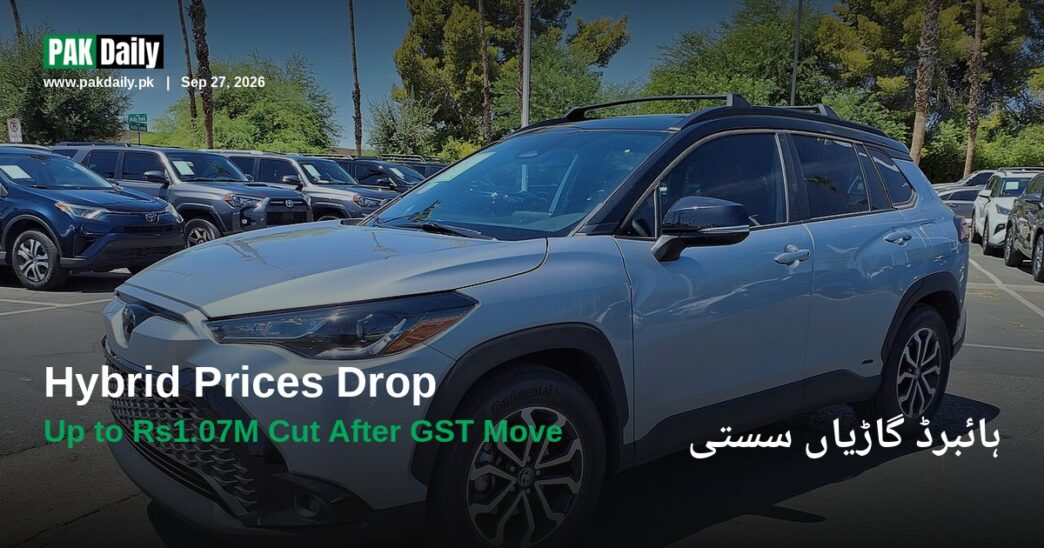
Buyers eyeing a hybrid SUV in Pakistan finally have something to smile about. Honda Atlas Cars and Indus Motor Company (Toyota) have both cut prices on their hybrid-electric lineups, with the biggest single cut running to just over Rs1 million, after the government slashed General Sales Tax (GST) on locally assembled vehicles up to 2,000cc from 25 percent to 18 percent.
The tax relief actually took effect on September 13, but as Dawn reported, assemblers sat on the change for almost two weeks before passing it on to customers — a delay industry watchers trace back to months of uncertainty over Pakistan’s auto policy. The Automotive Industrial Development Policy (AIDP) 2021-26, under which hybrids and EVs were taxed at a much lower 8.5 percent, expired on June 30, and with no replacement policy announced through July and August, manufacturers reportedly held back on invoicing new orders rather than commit to pricing that might shift again.
| Model | Old Price | New Price | Reduction |
|---|---|---|---|
| Honda HR-V e:HEV | Rs10.369 million | Rs9.299 million | Rs1.07 million |
| Honda HR-V VTIS | Rs7.799 million | Rs7.299 million | Rs500,000 |
| Toyota Corolla Cross HEV X | Rs10.299 million | Rs9.729 million | Rs570,000 |
| Toyota Corolla Cross HEV | Rs9.849 million | Rs9.299 million | Rs550,000 |
Honda Atlas has said the new pricing applies to limited existing stock and to fresh orders invoiced from September 25 onward, so buyers who booked earlier may need to check with their dealership on which price applies to their unit. ProPakistani’s report on the same price list corroborates the figures from Dawn, with both outlets citing the identical Rs1.07 million and Rs500,000 cuts on the two HR-V variants.
“The government’s decision to settle the general sales tax issue at 18pc from 25pc on electrified vehicles may revive sales, as consumers had delayed their purchases,” Chery’s Master Director of Sales and Marketing said, adding that most vehicles from his company and competitors should be delivered within two months.
The GST cut applies broadly to vehicles up to 2,000cc, so more assemblers are expected to follow Honda and Toyota’s lead in the coming days, though not every brand has updated its price list yet. A new, comprehensive auto policy to replace the expired AIDP is still pending, and industry officials say further pricing volatility is possible once that policy is finally unveiled — a point PakDaily previously covered when the FBR cut import duties on cars and other goods earlier this year as part of the broader push to bring vehicle prices down.
Our Opinion
A two-week gap between a tax cut taking effect and consumers actually seeing lower price tags is a small but telling symptom of how policy uncertainty ripples through Pakistan’s auto sector; assemblers were, in effect, hedging against the risk of a still-unannounced auto policy overturning today’s number tomorrow. The bigger test now is whether Islamabad can finally put a durable replacement for the AIDP in place — without one, every tax adjustment risks becoming a one-off event rather than the start of predictable, sustained relief for buyers who have already delayed purchases for months waiting for clarity.