

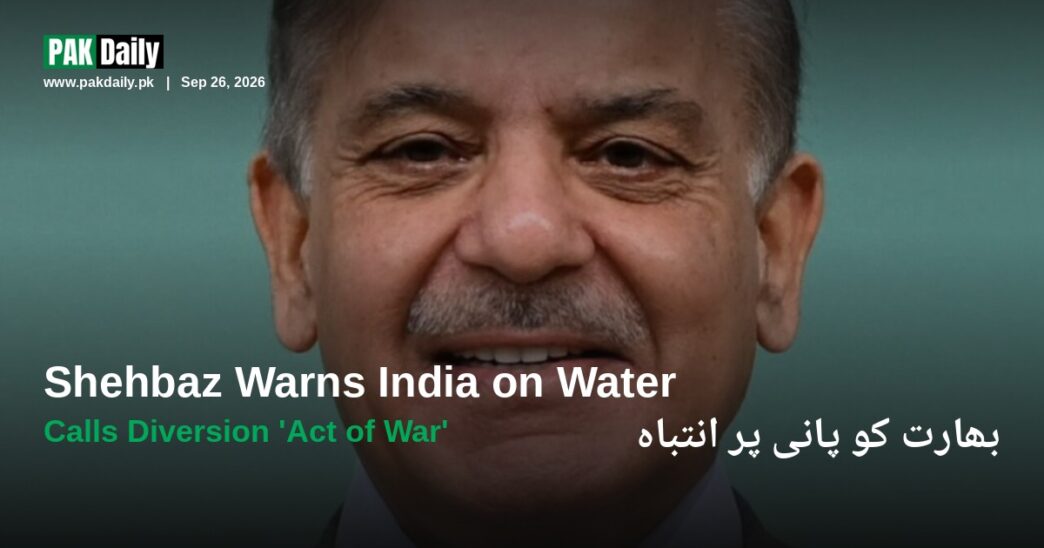
Prime Minister Shehbaz Sharif issued Pakistan’s sharpest warning yet to India over the Indus river system, telling the United Nations General Assembly in New York that any attempt to “stop, impede or divert” Pakistan’s share of the waters would be “treated as an act of war.” Addressing world leaders on September 25, the premier said “India must make no mistake about it,” directly naming Islamabad’s eastern neighbour in front of the full Assembly.
The remarks were his most direct escalation yet of Pakistan’s dispute with India over the Indus Waters Treaty, which New Delhi placed in abeyance last year following a militant attack in Indian-administered Kashmir. Sharif told the Assembly that India’s move had no legal basis, pointing out that both a UN-appointed neutral expert and the Permanent Court of Arbitration had already ruled against India’s position, leaving Pakistan, in his words, “vindicated beyond any ray of doubt,” according to Dawn.
“Water must never be weaponised. Rivers should nourish nations, not divide them,” Sharif told the Assembly, describing the Indus system as the “lifeblood” of the entire region.
Despite the sharp language, Sharif framed the water warning within a broader message of restraint, saying Pakistan had “chosen dialogue over confrontation” and “chosen peace over war,” per The Express Tribune. He also invoked Pakistan’s right to self-defence under the UN Charter over what he called “external aggression from India” a year earlier, and credited US President Donald Trump with having helped prevent the two nuclear-armed neighbours’ confrontation from escalating further, according to a report from UN News.
On Kashmir, Sharif said Kashmiris had “waited eight decades for a UN plebiscite” and accused India of “illegal occupation,” listing alleged abuses that he said included arbitrary detention, extrajudicial killings, enforced disappearances, sexual violence and collective punishment. He also condemned what he termed “RSS driven Hindutva ideology” for fuelling religious hatred, lynching and communal violence, per UN News’s account of the address.
The Prime Minister’s speech ranged well beyond South Asia. Among the other points he raised:
- He referenced a child killed in Gaza and accused Israel of pursuing a “genocidal agenda” in the West Bank.
- He highlighted Pakistan’s role in regional diplomacy, saying Islamabad had helped broker dialogue between Washington and Tehran over Gulf tensions.
India used its right of reply at the session to reject Sharif’s remarks outright. Petal Gahlot, First Secretary at India’s Permanent Mission to the UN, said the Assembly had “witnessed absurd theatrics from the Prime Minister of Pakistan, who once again glorified terrorism, the very core of their foreign policy,” according to a report carried by the Deccan Herald. Gahlot also referenced comments from India’s Air Chief that Indian forces had downed five Pakistani jets and one large aircraft during last year’s military confrontation, and said it was Pakistan’s military that had requested a ceasefire on May 10 after threatening strikes through May 9.
Our Opinion
Sharif’s “act of war” language is the starkest public framing Islamabad has put on the water dispute since India suspended the Indus Waters Treaty, and it plays well to a domestic audience anxious about upstream control of the country’s rivers; but a warning delivered from a UN podium, alongside talk of “dialogue over confrontation,” reads more as a bid to internationalise the issue and lean on the Permanent Court of Arbitration’s findings than as a signal of imminent escalation — the real test will be whether Pakistan can convert that legal vindication into any change in India’s actual conduct on the ground, rather than another exchange of hardened rhetoric at the world’s podiums.