
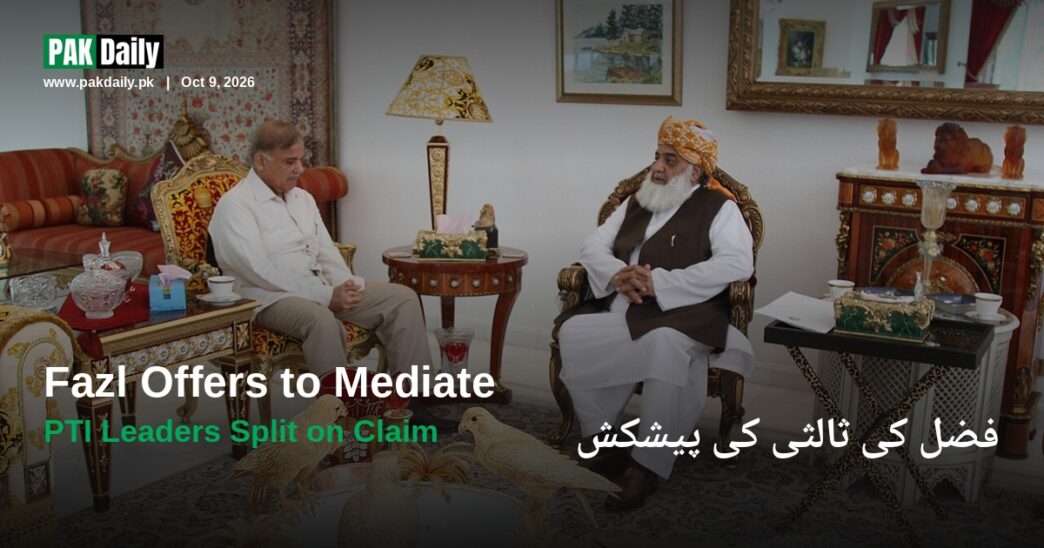
Pakistan’s government and PTI have both turned to JUI-F chief Maulana Fazlur Rehman in an attempt to break the deadlock over the party’s ongoing long march, though senior PTI figures are themselves giving conflicting accounts of whether he is actually playing that role.
According to The Express Tribune, a government negotiating committee — National Assembly Speaker Sardar Ayaz Sadiq, PM’s Adviser on Political Affairs Rana Sanaullah, and Dr Tariq Fazal Chaudhry — met Fazlur Rehman on Wednesday and reported back to Prime Minister Shehbaz Sharif on Thursday that the JUI-F chief was prepared to play a conciliatory role. Government sources told the paper he had urged a settlement through dialogue rather than governor’s rule or an emergency in Khyber Pakhtunkhwa, and that a phone call between the prime minister and Fazl was expected soon. Separately, Aaj News reported that Fazl has set five unspecified conditions for mediating and told both sides he would first gauge how serious they are about a solution before deciding whether to formally take on the role.
On the PTI side, the picture is less settled. PTI Khyber Pakhtunkhwa president Junaid Akbar told the private channel programme Dunya Mehar Bukhari Kay Sath that the party had authorised Fazl to mediate between the government and the opposition, and that PTI had no objection if the government wanted him in that role too. He said Fazl had asked PTI to delay the long march and wanted the matter resolved through dialogue. But PTI Secretary General Salman Akram Raja, speaking on Capital Talk the same day, categorically denied that Fazl was playing any mediatory role at all, saying the meeting with him only covered the country’s broader political situation. Adding a third voice, a spokesperson for the Tehreek-e-Tahaffuz-e-Ayeen-e-Pakistan (TTAP) alliance, Akhundzada Hussain, dismissed the mediation reports outright as “a story spun by the government or pro-government media,” and said PTI leaders Barrister Gohar, Junaid Akbar and Asad Qaiser had denied being approached by Fazl beyond an earlier meeting on a proposed All Parties Conference. Given these three conflicting PTI accounts on the same day, readers should treat any claim that Fazl is formally mediating as contested rather than settled.
“Our impression is that the government does not want the issues to be resolved through dialogue,” PTI’s Junaid Akbar said, adding that his party still regards street protest as its remaining “legal and constitutional option” when it is not heard.
Opposition leaders are also coordinating a harder line on preconditions. NA Opposition Leader Mahmood Khan Achakzai and Senate Opposition Leader Allama Raja Nasir Abbas spoke by phone and agreed that any talks with the government would be conditional on a meeting with Imran Khan, according to the Tribune. Raja separately said major national decisions could follow if PTI leaders were allowed to meet Khan, and that his inclusion was non-negotiable for any dialogue to proceed.
The mediation talk comes as PTI’s long march enters a new phase in Peshawar, with mobile and cellular internet suspended across several areas of the provincial capital for two days, disrupting daily life and business. A PTI statement said the convoy had reached the city’s toll plaza, where it was welcomed by Khyber Pakhtunkhwa Chief Minister Sohail Afridi, and that the march would grow into the largest in Pakistan’s history once it reaches Swabi. Sources told the Tribune that mobile services would likely be restored only once the march moves on toward Charsadda.
Our Opinion
That three senior PTI voices gave three different answers on the same day about whether Fazlur Rehman is actually mediating says less about Fazl himself — who has brokered talks between PTI and successive governments before — and more about the unresolved question of who within PTI currently has the authority to negotiate on the party’s behalf; until that internal clarity exists, any outside mediator’s role will remain hostage to being disowned by one PTI faction as soon as it is confirmed by another, which should temper optimism that this latest overture resolves anything quickly.