
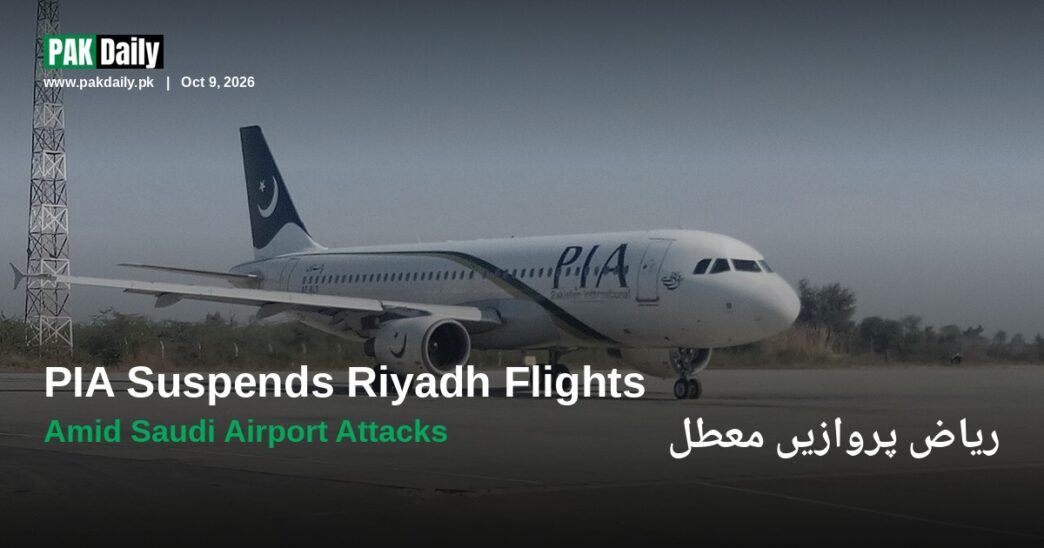
Pakistan International Airlines (PIA) has temporarily suspended its flights to Riyadh after a wave of Houthi missile and drone strikes on Saudi airports left three people dead and dozens injured this week. The Pakistan Airports Authority (PAA) confirmed the move on Friday, saying PIA “has temporarily suspended flights only to Riyadh” while operations to the rest of Saudi Arabia continue as normal. PIA spokesperson Abdullah Hafiz Khan said flight PK-753 (Islamabad to Riyadh) and the return leg PK-754 were among those cancelled, and the airline apologised for the inconvenience, advising passengers to call its helpline at 111-786-786 to confirm their flight status before heading to the airport.
The suspension follows a sharp escalation in Yemen’s Houthi movement targeting Saudi aviation infrastructure. According to Saudi Arabia’s General Authority of Civil Aviation, attacks this week on King Khalid International Airport in Riyadh and Abha International Airport killed three Saudi nationals and injured 36 people, including one Pakistani national, with one strike damaging airport facilities and another hitting a Saudia aircraft on the ground. Houthi military spokesman Yahya Saree claimed the group had fired a ballistic missile at King Khalid airport and said the strike had disrupted air traffic there, while a Saudi-led coalition spokesman said several incoming missiles, including ones aimed at Riyadh and Khamis Mushait, had been intercepted. The Houthis, an Iran-aligned movement, have tied the attacks to Saudi Arabia’s backing of an offensive against them in Yemen’s renewed civil war.
“Flight operations to Saudi Arabia are continuing as usual,” the Pakistan Airports Authority said, dismissing circulating social media claims of a wider shutdown as “not true” and stressing that only the Riyadh route had been affected.
PIA is far from alone in pulling back from the Saudi capital. Several major international carriers have announced their own suspensions or route adjustments in response to the escalating conflict:
| Airline | Action | Duration |
|---|---|---|
| PIA | Suspended Riyadh flights | Temporary, no date given |
| Lufthansa Group | Suspended Riyadh flights | Until October 16 |
| IndiGo | Cancelled all Riyadh flights | Through October 9 |
| Air India & Akasa Air | Cancelled Riyadh flights | Through October 10 |
| EgyptAir & Philippine Airlines | Suspended Riyadh service | Not specified |
The ripple effect has been significant. Flight-tracking service Flightradar24 recorded 104 flights cancelled and 154 delayed into and out of Riyadh on Friday alone, after 335 cancellations the day before, according to Propakistani. The disruption has also been felt at Pakistani airports handling Saudi-bound traffic: ARY News reported roughly 42 flights cancelled across the country on Friday, including 13 at Lahore’s Allama Iqbal International Airport, 10 at Karachi, nine at Islamabad, and seven at Multan, with dozens more delayed at each. The European Union Aviation Safety Agency has also expanded the no-fly zone it advises operators to observe over parts of Saudi airspace, citing the risk to civil aviation.
The disruption comes as Islamabad has moved to publicly back Riyadh. According to Dawn and The Express Tribune, Prime Minister Shehbaz Sharif condemned the Houthi attacks and reaffirmed Pakistan’s commitment to Saudi Arabia’s security under the Makkah Defence Pact, a mutual-defence arrangement between the two countries. Pakistan’s Foreign Office has separately said the pact’s provisions could become operational if the kingdom’s sovereignty continues to come under attack, underlining how directly the Gulf security situation is now being felt in Islamabad, not just at the departure gates of PIA’s Riyadh counter.
Our Opinion
A single suspended route between Islamabad and Riyadh is a small operational decision on its own, but it is a useful barometer of how quickly a regional conflict can reach ordinary travellers, remittance-sending workers, and pilgrims who depend on that corridor; the bigger test for PIA and Pakistan’s aviation regulators will be whether they can communicate clearly and consistently as the situation evolves, since Friday’s rush to knock down “wider shutdown” rumours shows how easily confusion spreads when an airline’s own statements lag behind the news.