

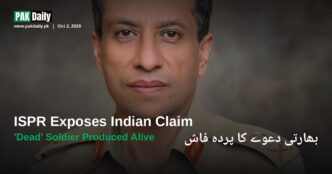
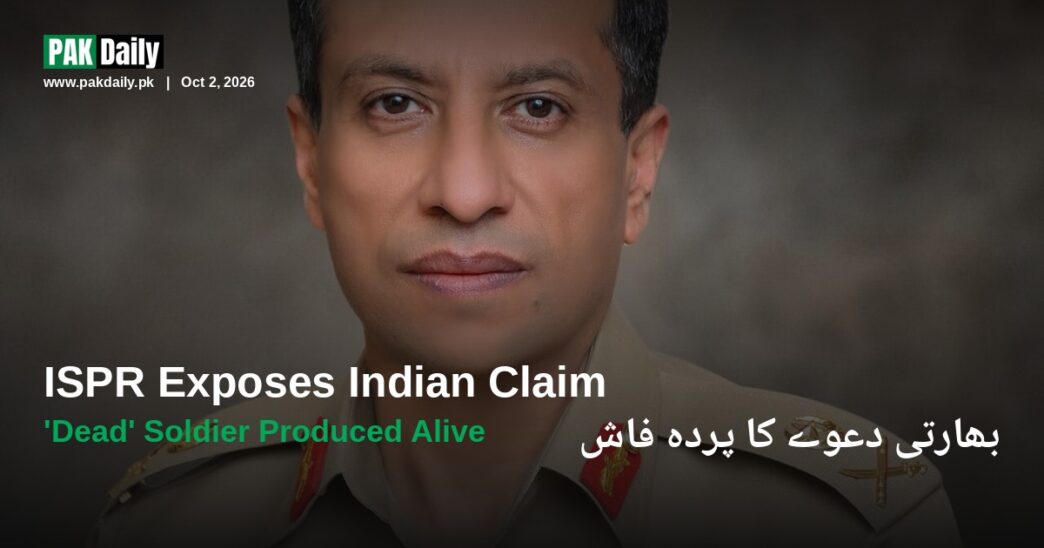
Pakistan’s military on Thursday produced a retired soldier alive in front of television cameras to rebut an Indian claim that its forces had killed him in occupied Kashmir, in the latest flashpoint in the two countries’ long-running information war.
Director General of Inter-Services Public Relations (ISPR) Lt Gen Ahmed Sharif Chaudhry told a press conference in Rawalpindi on October 1 that Havildar (retd) Muhammad Asif — identified by Indian media as “Hashim Moosa,” a Lashkar-e-Taiba militant allegedly killed in a joint search operation in Korag, Yousmarg, in Indian-occupied Kashmir — was in fact alive and living with his family in Rawalpindi.
According to Dawn and The News, the episode began on the night of September 29-30, when Indian military accounts and outlets including News18, India Today, Hindustan Times and ANI reported that security forces had “neutralised” a terrorist in an operation India’s home ministry linked to “Operation Sheruwali,” launched in May 2026. The reports carried detailed biographical claims about the slain man — a 1980 birth date, a 2000 enrolment in the Pakistan Army, induction into the Special Services Group (SSG) in 2005, service in Balochistan, and a stint on VVIP security for former president Pervez Musharraf.
Those details, ISPR said, matched the real service record of Muhammad Asif of Pindi Gheb, Attock — an SSG veteran who retired as a Havildar in 2023 after 18 years of service and now works for a private security firm. Asif was brought before reporters in person.
“I was surprised — I was at home, so how could the Indian Army have martyred me? I am very much alive, I live in Rawalpindi, and I am before you,” Asif told the briefing, calling the Indian reports “false, ignominious and disreputable.”
Lt Gen Chaudhry used the briefing to accuse India of fabricating the encounter for domestic political purposes, drawing a comparison to previous disputed incidents. “You might be recalling Uri, Pahalgam and Pulwama — a very interesting story is being cooked,” he said, adding that India had turned into what he called “Encounter-stan.” He also warned that any future provocation would carry a heavy cost: “This time the cost that Pakistan would inflict on their strategic folly will be very, very severe.”
The DG ISPR laid out several reasons he said were driving India to stage such claims, including:
- Deflecting attention from India’s own alleged role in sponsoring militancy in the region
- Diverting from the heavy security deployment and unrest in occupied Kashmir
- Domestic political pressure to show results against Pakistan
- Pressure on the Indian military to produce a media-friendly narrative
As of the time of the press conference, Indian officials and military sources had not issued a public response to Pakistan’s rebuttal, according to both Dawn and The News.
The incident is the latest in a string of friction points between the two nuclear-armed neighbours since the April 2025 Pahalgam attack in occupied Kashmir, which left more than two dozen dead and triggered a brief but intense military confrontation between the two countries the following month. Tensions have periodically resurfaced since, including Prime Minister Shehbaz Sharif’s warning last month that India diverting water from shared rivers would be treated as “an act of war.”
Our Opinion
Whatever actually happened in Korag on the night of September 29, the speed and confidence with which this claim unravelled says something uncomfortable about how India-Pakistan incidents now get reported on both sides of the border — a military press release goes out, a national broadcast machine builds a narrative around it within hours, and the inconvenient process of basic verification only happens afterward, if at all; Pakistan’s own information apparatus is not above the same instinct to dramatize, and ISPR’s press conference was every bit as theatrical as the claim it was rebutting, so the right takeaway here isn’t a scorecard of who “won” this round but a reminder that a one-word denial or social media post from either country’s military should never be treated as established fact until someone, somewhere, has actually checked.