


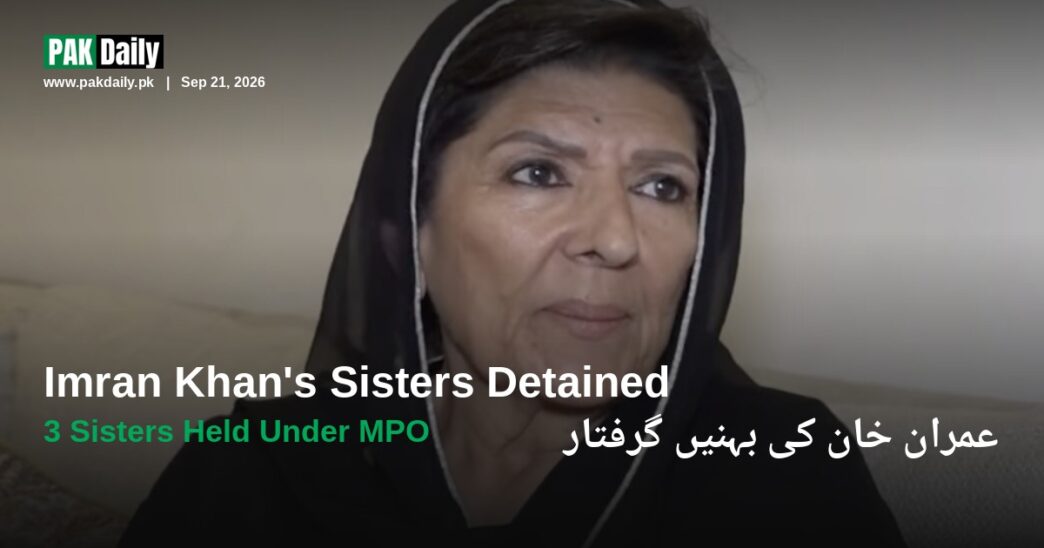
Three sisters of PTI founder Imran Khan — Aleema Khan, Dr Uzma Khan and Noreen Niazi — have been placed under 30-day preventive detention in Lahore under Punjab’s Maintenance of Public Order (MPO) Ordinance, 1960, just a week before PTI’s planned September 27 march to Islamabad demanding Imran Khan’s release.
Aleema Khan was the first to be detained, taken into custody on Sunday, September 20, and shifted to Kot Lakhpat jail. Her younger sisters, Dr Uzma Khan and Noreen Niazi, followed a day later under a Monday order from the Lahore deputy commissioner’s office, and are being held at the same facility. According to Dawn, the detention orders describe all three as “prejudicial to the public safety and maintenance of public order,” citing their alleged involvement in the May 9 protests and accusing them of “mobilising the workers through social media…to create a law and order situation.”
| Name | Detained | Held At | Legal Basis | Duration |
|---|---|---|---|---|
| Aleema Khan | Sunday, Sep 20 | Kot Lakhpat Jail, Lahore | Punjab MPO Ordinance, 1960 | 30 days |
| Dr Uzma Khan | Monday, Sep 21 | Kot Lakhpat Jail, Lahore | Punjab MPO Ordinance, 1960 | 30 days |
| Noreen Niazi | Monday, Sep 21 | Kot Lakhpat Jail, Lahore | Punjab MPO Ordinance, 1960 | 30 days |
PTI’s legal team says the sisters were taken without warning. Party lawyer Awais Younas Chaudhry told reporters that Uzma and Noreen had until Monday morning been confined to their own home before being “taken to an unknown place,” while PTI spokesperson Sheikh Waqas Akram said they were moved “in an armoured vehicle.” Imran Khan’s son, Kasim Khan, called the action a “disgrace” on social media, adding that authorities “forced them into vehicles with no explanation.”
“Blatant abuse of authority, a violation of fundamental rights, and an act of political victimisation,” PTI said in an official statement reacting to the detentions.
Aleema Khan’s counsel, Rana Mudassar Umer, has since challenged her detention in the Lahore High Court. PTI maintains dozens of other party workers and office-bearers have been similarly picked up across Punjab and Islamabad in the run-up to the September 27 march.
Government’s Response
Interior Minister Mohsin Naqvi addressed the detentions and the upcoming march on Monday, warning PTI against going ahead with it. “We have clearly told them that they can never achieve anything through such drama,” Naqvi said, according to Dawn, urging the party to “not enter a dead-end street.” Asked about a lasting solution to PTI’s recurring protests, he said: “I believe this time we will find a permanent solution; we will not leave it halfway.”
Naqvi also pointed to a recent Islamabad High Court ruling that bars political parties from occupying public roads during demonstrations, saying the government intends to enforce it without “leaving any loopholes.” On PTI’s separate demand for an independent medical check-up for Imran Khan, Naqvi suggested the examination “may have already taken place at a hospital during the night.”
This is not the first time the two sides have squared off over a planned Islamabad march — PakDaily first reported on PTI’s call for the September 27 demonstration when it was announced earlier this month, with the party’s central demand unchanged: Imran Khan’s release.
Our Opinion
The pattern here is a familiar one in Pakistani politics — a preventive-detention law meant for genuine public-order emergencies being reached for, again, in the days before a major opposition rally, and against people whose only apparent link to any unrest is their surname; whatever the merits of the specific allegations against Aleema Khan, Uzma Khan and Noreen Niazi, detaining three sisters of a jailed former prime minister a week before a planned march invites the obvious question of proportionality, and the government would do itself credit by making its evidence public rather than leaving the courts, once again, to sort out where public order ends and political pressure begins.