

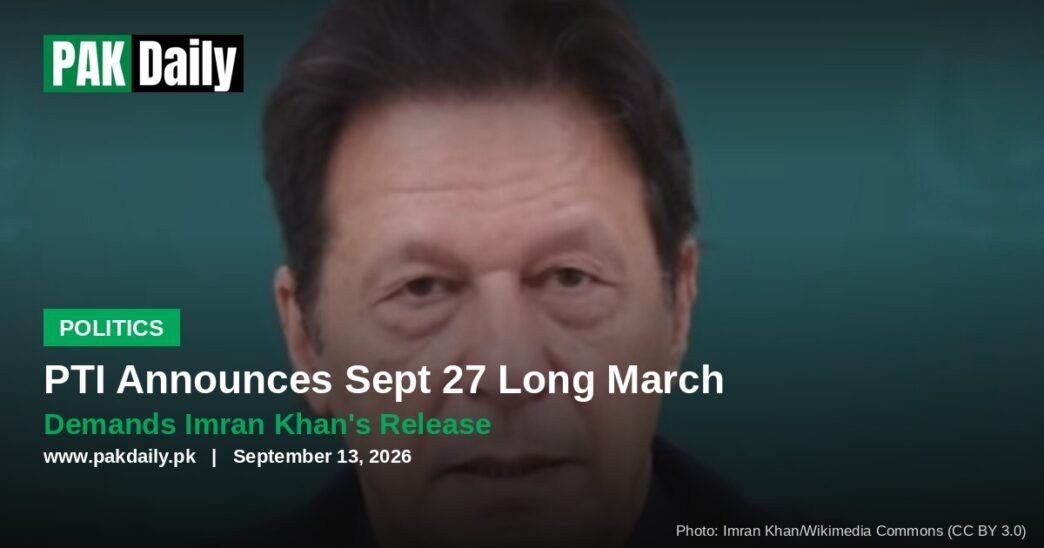
Pakistan Tehreek-e-Insaf (PTI) has announced a long march to Islamabad on September 27, its biggest planned show of street strength since founder Imran Khan’s imprisonment, with the party demanding his release, “restoration of constitutional rule,” and relief from inflation.
Khyber-Pakhtunkhwa Information Minister Shafi Jan said the decision was taken “through mutual consultation between the party and its allies” and that the march would proceed with full preparation, potentially lasting several days, according to The Express Tribune. K-P Chief Minister Sohail Afridi first announced the march in Peshawar, and the party says it is mobilizing supporters across Punjab and other provinces, including university seminars aimed at younger voters.
What PTI Is Demanding
- Release of PTI founder Imran Khan from Adiala Jail
- Restoration of what the party calls constitutional rule
- Economic relief from ongoing inflation
- Return of the “public mandate” PTI says was taken from it
- Broader restoration of democratic process
A Party Divided Over Its Own March
The announcement has exposed a rift inside PTI itself. PTI Central Information Secretary Sheikh Waqas Akram said the party’s central leadership “had not been taken into confidence” before Afridi’s announcement, and a hashtag translating to “27 September Long March Unacceptable” has circulated among K-P party workers opposed to the move, Tribune reported separately.
Akram said Imran Khan had authorized Afridi to lead street movements independently — but multiple party insiders dispute that account, saying the announcement caught central leadership off guard.
Whether the march goes ahead as a unified party action or a K-P-led initiative with uneven support elsewhere remains an open question two weeks out from the planned date.
Khan’s Situation Behind the March
Khan, who has been in Adiala Jail since May 2023 following his ouster as prime minister in April 2022, was briefly moved to a private hospital in August after the Supreme Court ordered his transfer amid what Al Jazeera described as an access battle between his lawyers and jail authorities. He was returned to Adiala Jail the same week following a medical check, with authorities saying he was in stable health, according to Al Jazeera.
Khan is serving a 17-year sentence handed down in December 2025 in the Toshakhana case and faces ongoing trials under anti-terrorism legislation tied to the May 2023 protests that followed his arrest.
Our Opinion
A long march is a legitimate form of political protest in any democracy, and PTI’s core demands — Khan’s release, an end to what it calls arbitrary detention, and relief from inflation that affects every Pakistani household — are the kind of claims that deserve to be argued out in courts and at the ballot box rather than settled by street pressure alone.
What stands out just as much as the march itself is the confusion over who actually called it. A major party mobilizing supporters nationwide while its own central leadership says it wasn’t consulted points to a deeper organizational strain, not just a scheduling disagreement. Whatever happens on September 27, Pakistan’s institutions — the judiciary handling Khan’s cases, the party managing its own chain of command, and the government responding to planned protests — will all be watched for whether they can handle this moment without further escalation on any side.