
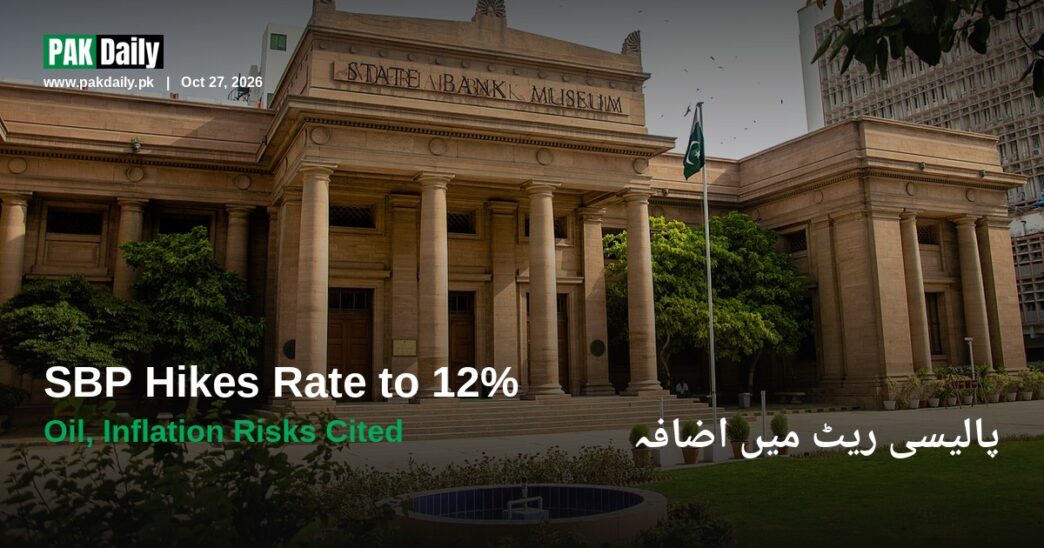
Pakistan’s central bank raised its benchmark interest rate by 50 basis points to 12 percent on Monday, pointing to inflation risks stemming from the Iran war and its effect on global oil prices. The State Bank of Pakistan’s (SBP) Monetary Policy Committee (MPC) announced the increase from 11.5 percent after its third meeting of the current fiscal year, Dawn reported.
Nine of the MPC’s ten members voted for the 50-basis-point move, while one member had pushed for a steeper hike, according to Dawn. That is a markedly more hawkish committee than at its previous meeting on September 14, when only three of ten members wanted a 100-basis-point increase and the remaining seven voted to hold. The increase comes weeks after Governor Jameel Ahmed said Pakistan’s economy had grown more resilient to external shocks — a claim now being tested by the regional oil shock.
Ahmed said the decision reflected a mix of “underlying factors,” chiefly the inflation outlook, Dawn reported. Among the reasons cited by the governor:
- the fallout from the US-Israel war on Iran and its effect on energy and oil prices
- domestic market developments and rising consumer and forecaster inflation expectations
- the impact of global commodity and oil prices on Pakistan’s external account
- trends in remittances and exports
The move was widely expected. A pre-decision investor poll by Topline Securities found 61 percent of respondents expected some increase, with 54 percent predicting exactly 50 basis points, Business Recorder reported. Foundation Securities called it a “measured, pre-emptive move,” though the Pakistan Institute of Development Economics (PIDE) had instead urged the SBP to hold steady.
| MPC Decision | Policy Rate | Change |
|---|---|---|
| June 2023 (record peak) | 22% | — |
| April 2026 | 11.5% | +100 bps (first hike in nearly 3 years) |
| July 2026 | 11.5% | Held |
| Sept 14, 2026 | 11.5% | Held |
| Oct 26, 2026 | 12% | +50 bps |
The SBP’s September policy statement had cited headline inflation of 11.1 percent year-on-year in August, up from 9.2 percent in July. PIDE separately said headline inflation moderated to 10.26 percent in September, while a Business Recorder analysis put the April-September average at 10.7 percent. Topline projects FY27 average inflation at 9 to 9.5 percent, assuming Brent crude averages around $100 a barrel.
Brent crude, which had climbed above $115 a barrel amid the Iran war, had eased to around $101 by Monday on hopes that hostilities would de-escalate — a swing that has also rattled the Pakistan Stock Exchange in recent sessions. Disruption to trade with Iran has already triggered LPG shortages and price spikes, with officials warning of further strain on gas supply this winter.
On the currency side, the interbank US dollar-rupee rate stood at 277.01 on Monday, according to Business Recorder’s market data. Pakistan’s real effective exchange rate (REER) is near 109 — its highest in eight years — meaning the rupee has been appreciating in real terms even as the nominal rate holds almost flat. A Business Recorder column argued this stability is being treated as a political priority that leaves the SBP with less room to manage inflation through the exchange rate alone.
Pakistan’s current account deficit widened to $874 million in the first quarter of FY27, up from $755 million a year earlier, as non-oil imports rose 15 percent and petroleum imports rose 6 percent. The country has nonetheless regained access to international debt markets, foreign exchange reserves are at record levels, and credit ratings have improved over the past year.
The rate hike split Pakistan’s business community, according to a separate Dawn report. Overseas Investors Chamber of Commerce and Industry (OICCI) Secretary General M. Abdul Aleem welcomed it as necessary to contain inflation, though he said sustaining growth now depends on supply-side reforms, fiscal discipline, competitive energy tariffs and a broader tax base. Domestic industry bodies were far less enthusiastic:
- Federation of Pakistan Chambers of Commerce and Industry (FPCCI) President Atif Ikram Sheikh called the new rate uncompetitive, argued Pakistan’s inflation is mainly supply-side and fiscal in nature, and said he wants a single-digit policy rate
- Karachi Chamber of Commerce and Industry (KCCI) President Talat Mahmood said the hike raises the cost of doing business and discourages investment
- SITE Association of Industry President Abdul Hadi said factories are already running well below capacity and financing will now get harder
- Pakistan Textile Exporters Association Chairman Rehan Naseem Bharara said the move will push up working-capital costs and weaken exporters’ global competitiveness
Our Opinion
A central bank caught between a politically sensitive, near-flat rupee and a genuine oil-driven inflation shock will usually lean toward caution, and a 50-basis-point hike split 9-1 on the MPC suggests the SBP is trying to signal firmness without over-tightening into an already slowing industrial base; the real test, though, is whether the government addresses the energy-cost and fiscal pressures that the FPCCI, KCCI and SITE associations are all pointing to, since raising the policy rate does little to fix a supply shock originating in Tehran’s war with Israel, and if Brent crude stays elevated through winter, this is unlikely to be the last hike of the cycle.