
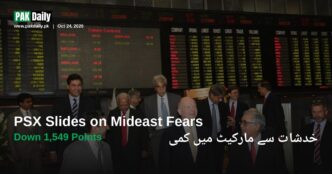
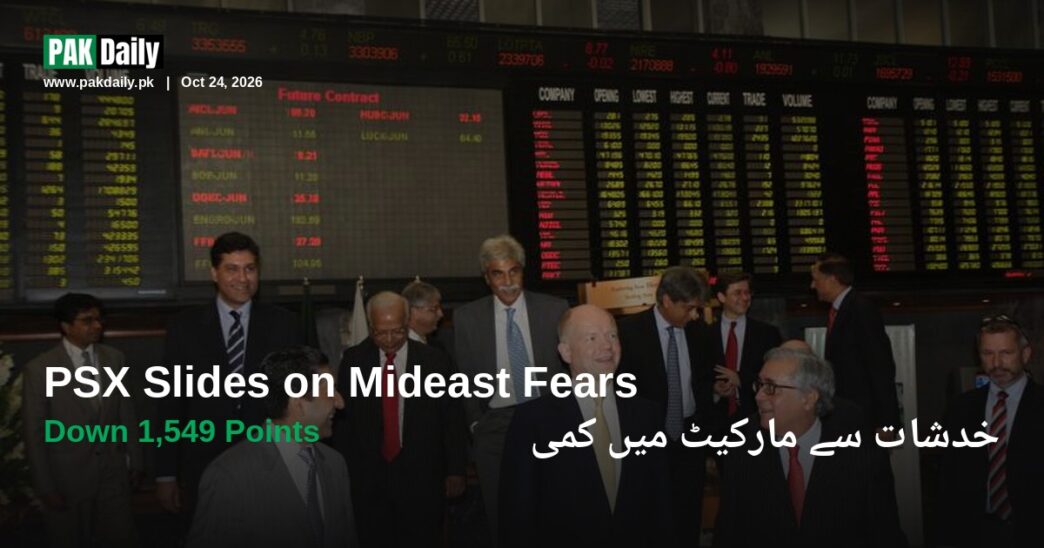
The Pakistan Stock Exchange’s benchmark KSE-100 index fell 1,549.44 points, or 0.95 percent, in Friday’s session to close at 162,374.88, as fears of a fresh military confrontation between the United States and Iran pushed international oil prices to their highest level since April, according to Daily Times and The Express Tribune’s intraday market trackers.
The decline capped a brutal week for the exchange. The index had gained 779.34 points on Wednesday before reversing sharply, shedding 2,006.67 points (1.21 percent) on Thursday and a further 1,549.44 points on Friday — a combined weekly loss of 2.43 percent, Arif Habib Limited noted in its post-session commentary.
| Session | Close (KSE-100) | Change (Points) | Change (%) |
|---|---|---|---|
| Wednesday, Oct 21 | 165,930.99 | +779.34 | +0.47% |
| Thursday, Oct 22 | 163,924.31 | -2,006.67 | -1.21% |
| Friday, Oct 23 | 162,374.88 | -1,549.44 | -0.95% |
The selling pressure traces back to Washington. Speaking at a midterm rally in Fort Myers, Florida on Thursday, US President Donald Trump raised the possibility of a fresh strike on Iran, saying “we may do another little ‘Operation Rising Fury'” — a reference to the US codename for joining Israel’s airstrikes on Iran in late February, which opened the current war. The New York Times reported on October 21 that the US and Israel have already drawn up plans for a short, concentrated strike, with fighter jets reportedly practising flights over Iraq and cited targets including Iran’s energy infrastructure, nuclear facilities, and missile and drone capabilities.
Tehran has signalled it will not back down. Two senior Iranian officials told Reuters that the country has detailed plans to target undersea cables in the Gulf if attacked, with one warning that military bases — including covert installations — could also come under fire, and that Iran “would have no further red lines.” In response, foreign ministers from Saudi Arabia, Egypt, Pakistan, Turkey, France, Germany, Britain and Italy met in Istanbul on October 23 and warned that a new military confrontation would not resolve the conflict and would likely widen the fighting while pushing oil prices even higher.
- Brent crude for December delivery settled at $116.72 a barrel on Thursday, up $3.55 (3.14 percent) — its highest level since April and roughly 20 percent above early-September levels, with an intraday high of $117.14.
- West Texas Intermediate for December delivery closed up $3.80 (3.82 percent) at $103.27 a barrel.
- Trump’s rally remarks followed the NYT report on US-Israel strike planning, which said any action could come only after the US midterm elections.
- Iran’s Gulf undersea-cable threat and warning of no further red lines raised the stakes further, pushing energy markets into a fresh risk premium.
On the PSX trading floor, the heaviest drags on Friday came from Meezan Bank, Engro Holdings, Lucky Cement, Hub Power Company and Pakistan Petroleum, which together erased roughly 637 points from the index. Ready market volume rose to 398.94 million shares worth Rs18.20 billion, while foreign investors were net sellers, offloading shares worth Rs416.6 million. Topline Securities, commenting on Thursday’s steeper fall, said persistent geopolitical uncertainty kept investors defensive and that an “absence of positive triggers further dampened sentiment.”
Arif Habib Limited described the session as one of “broad-based selling pressure” extending a recent run of declines, adding that profit-taking ahead of the State Bank of Pakistan’s upcoming monetary policy announcement added to the downward momentum. The brokerage’s technical outlook flagged potential downside toward the 160,000 level, with resistance now seen near 166,000.
This is the second sharp single-day fall for the index this month — the KSE-100 tumbled more than 2,000 points in early October after a round of government-opposition talks collapsed, underlining how sensitive the market has become to both domestic political shocks and external geopolitical risk this quarter.
Our Opinion
A nearly 2.5 percent weekly slide driven almost entirely by events thousands of miles away is a reminder of how exposed Pakistan’s financial markets remain to global energy shocks; with the current account and import bill both sensitive to oil prices, a prolonged US-Iran standoff would test the cushion built up through recent reserve gains far more than any single bad trading session can show, and the coming days of diplomacy in Istanbul matter as much to Karachi’s trading floor as they do to the region itself.