
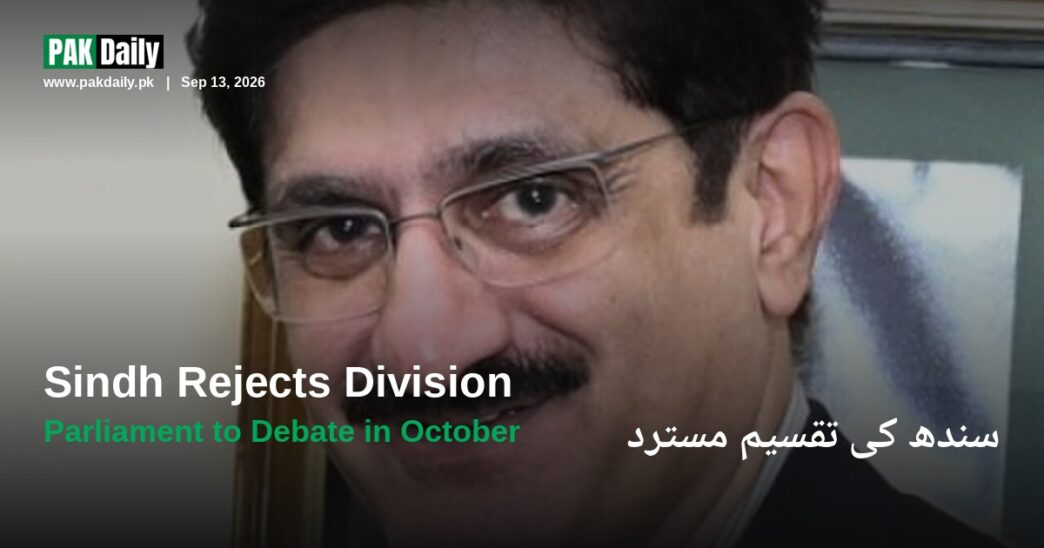
Pakistan’s long-simmering debate over carving new provinces out of existing ones has flared up again, with the Sindh Assembly passing a resolution rejecting any division of the province even as MQM-P intensifies its campaign for a separate administrative unit covering urban Sindh, including Karachi.
The Sindh Assembly resolution, adopted on September 3, declared that “Sindh is one and shall remain one” and reaffirmed that any change to the province’s territorial limits would require a two-thirds majority vote, according to Dawn. All 105 PPP lawmakers present backed the resolution, with some members displaying banners reading “Sindh Ji Dharti Munhinji Maa” (The Land of Sindh is My Mother). MQM-P and Jamaat-i-Islami walked out before the vote, protesting that three amendments they had proposed — covering administrative devolution rather than outright division — were excluded from the final text, Dawn reported. No PTI lawmakers were present for the vote.
Sindh Chief Minister Syed Murad Ali Shah was unequivocal in his response to MQM-P’s push, according to the Express Tribune:
“If you have the courage, bring a resolution for the division of Sindh and show us.”
Senior PPP leader Faryal Talpur echoed the sentiment, saying, “We will not allow Sindh to be divided. We will not sell Sindh,” while party lawmaker Nisar Ahmed Khuhro criticised opposition members for walking out, noting: “When it is time for voting, they walk out.”
MQM-P Says Urban Sindh’s Case Is “Strongest”
MQM-P, meanwhile, has been turning up pressure for a new province built around Karachi and urban Sindh, arguing its case is the strongest among the various new-province demands being discussed nationally. Party chairman and Federal Education Minister Dr Khalid Maqbool Siddiqui said provinces should ultimately be administrative divisions based on population, and argued that an honest census and corrected voter rolls would eventually compel even the PPP to demand a new province, according to the Express Tribune.
Senior MQM-P leader Dr Farooq Sattar was more pointed, criticising the country’s four provinces as being “effectively controlled by a handful of families,” and said the party has submitted a constitutional amendment bill aimed at strengthening local governments under Article 140-A. Business leaders and former officials cited in the same report, including Rehan Hanif, Atiq Mir and Barrister Shahab Imam, pointed to Karachi’s deteriorating infrastructure and hiring practices in public institutions that they say favour non-locals over the city’s residents. MQM-P has also called for a public referendum on the issue under Article 48(6) of the Constitution.
A Wider National Debate, Headed to Parliament in October
The renewed push isn’t confined to Sindh. The broader conversation about creating additional provinces or administrative units was set in motion by Interior Minister Mohsin Naqvi on July 30, who framed it as part of a wider overhaul of the country’s governance structure meant to improve service delivery and create opportunities for the country’s youth.
Parliamentary Affairs Minister Tariq Fazal Chaudhry has since confirmed that the matter will be formally debated in both the National Assembly and the Senate when they reconvene in October, telling reporters “the proper forum for this discussion is the parliament,” per the Express Tribune. He said the government would consult other political parties, incorporate stakeholder feedback and draft legislation based on international precedent, while still working out whether a simple or two-thirds majority would ultimately be required to approve any new province. Separately, a five-member ministerial committee has recommended a dedicated legislative assembly for Islamabad’s governance, though officials say the capital will remain a federal territory rather than become a province in its own right.
Not every party is on board. PTI chairman Barrister Gohar Ali Khan warned on September 7 that dividing provinces “without the consent of its people” risked weakening the federation, positioning PTI closer to PPP’s opposition even as PTI lawmakers skipped the Sindh Assembly vote. Defence Minister Khawaja Asif and the prime minister’s adviser Rana Sanaullah have both stressed that any resolution should come through political consensus rather than a unilateral push by any one party.
| Date | Development |
|---|---|
| July 30, 2026 | Interior Minister Mohsin Naqvi opens the national debate on new provinces/administrative units |
| August 2026 | MQM-P formally endorses creation of new provinces, citing population growth and governance strain |
| September 3, 2026 | Sindh Assembly passes resolution rejecting division of the province; MQM-P and JI walk out |
| September 7, 2026 | PTI’s Barrister Gohar Ali Khan warns against dividing provinces without public consent |
| October 2026 | National Assembly and Senate scheduled to formally debate new provinces |
Our Opinion
Pakistan’s provincial map has been redrawn before, and each time it’s taken years of hard bargaining rather than a single vote — what’s notable this time is that the debate is happening openly in parliament and provincial assemblies rather than behind closed doors, which is a healthier starting point. Still, the sharply differing accounts of what MQM-P’s own amendments actually proposed — administrative devolution, in the party’s telling, versus a fuller provincial split, as framed by critics — suggest much of this fight is still being fought over definitions rather than substance, and whatever Parliament decides in October will only hold up if it’s seen as genuinely consultative rather than a numbers game won by whichever bloc has the votes on a given day.