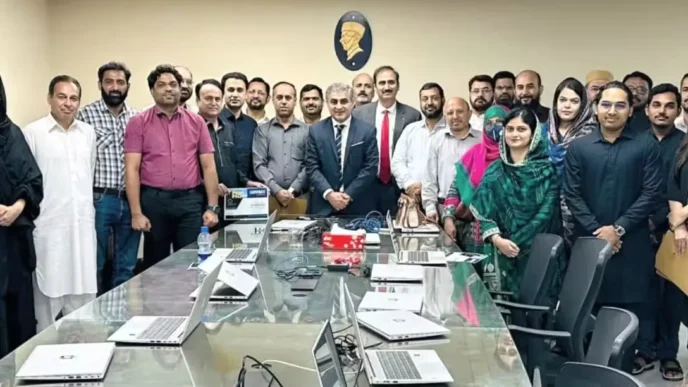



Prime Minister Shehbaz Sharif chaired a high-level review meeting in Islamabad on Wednesday on artificial intelligence and digitalisation in the economy and governance, directing federal ministries to roll out a slate of AI projects developed with Chinese tech giant Alibaba Group by November 2026, according to a statement issued by the Prime Minister’s Office and reported by Dawn and The Express Tribune.
“The secret to Pakistan’s development lies in artificial intelligence and digitisation,” PM Shehbaz told the meeting, adding that effective use of AI and digital technology could play a vital role in improving trade, exports and agricultural productivity.
The meeting, attended by Finance Minister Muhammad Aurangzeb, Planning Minister Ahsan Iqbal, Petroleum Minister Musadik Malik, IT Minister Shaza Fatima Khawaja and several other federal ministers and senior officials, set firm deadlines on a number of fronts:
- Healthcare: An AI-assisted early cancer-detection system, developed in partnership with Alibaba, is to be implemented “at the earliest.”
- Skills training: A 15-day AI training programme for IT graduates will be launched through the Ministry of IT’s Ignite programme in collaboration with Alibaba.
- Energy: The Oil and Gas Regulatory Authority (OGRA) has been directed to promptly introduce an AI-based analytics system to monitor the petroleum products supply chain.
- Trade: The Export Promotion Bureau has been told to work with Alibaba to boost Pakistani exports.
- Accountability: Every project must carry clear targets, timelines and monitoring mechanisms, with ministries required to submit progress reports by November 2026.
Officials at the meeting also reported progress already underway on several fronts: AI-based agricultural models are in development, a tobacco track-and-trace system is being built, and digital export platforms for citrus and olive produce are in the works. A “Pakistan Pavilion” has been set up on Alibaba’s e-commerce platform, while trade-document verification has gone digital through the Pakistan Single Window system. A two-year programme between the Small and Medium Enterprises Development Authority (SMEDA) and Alibaba is also set to give Pakistani SMEs e-commerce tools, training and market access, and a new central data hub is being developed for the Federal Board of Revenue (FBR) and its IT arm, PRAL.
Wednesday’s review builds on a cooperation framework that has been taking shape over several months:
- May 24, 2026: PM Shehbaz visited Alibaba’s Hangzhou headquarters and signed a comprehensive strategic framework with Chairman Joe Tsai covering AI, cloud computing, digital trade, SME support, fintech and healthcare, calling it a step toward making Pakistan “an emerging regional hub for the digital economy.”
- July 2026: Pakistan became a founding member of China’s World AI Cooperation Organisation (WAICO), with Deputy PM and Foreign Minister Ishaq Dar signing on in Shanghai.
- July 24, 2026: The PM inaugurated the AI cloud platform “Sky47” in Rawalpindi.
- October 28, 2026: Wednesday’s meeting served as a progress and accountability check on the commitments made since May, setting a November deadline for ministries to show results.
The government has previously set a broader target of investing $1 billion in AI by 2030, part of a wider push to position technology and digitisation as a central plank of Pakistan’s economic recovery strategy.
Our Opinion
Pakistan’s enthusiasm for AI partnerships has been consistent since May, but the real test lies in execution rather than announcements; a cancer-detection system, a supply-chain monitoring tool for OGRA, and SME onboarding onto Alibaba’s platform are all meaningful ideas, yet each depends on bureaucratic follow-through that past digitisation drives in Pakistan have often struggled to sustain past the launch event. Setting a hard November 2026 reporting deadline is a sensible accountability mechanism, and if even two or three of these pilot projects survive contact with implementation, it would mark genuine progress; the government would do well to publish those progress reports publicly rather than let them disappear into internal paperwork, since public tech initiatives tend to move faster when the public can actually see whether the deadlines were met.