

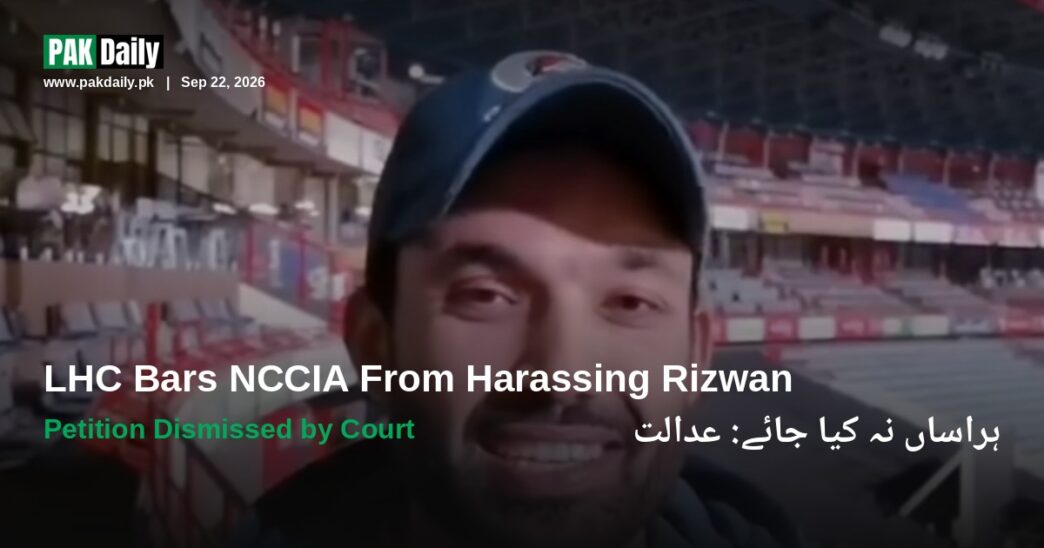
The Lahore High Court (LHC) has dismissed Mohammad Rizwan’s petition challenging a National Cyber Crime Investigation Agency (NCCIA) inquiry into the wicketkeeper-batter, but at the same time directed the agency not to cause him “harassment or unnecessary inconvenience” while the probe continues. Chief Justice Aalia Neelum released the court’s detailed written order on Monday, five days after orally rejecting Rizwan’s petition at a September 17 hearing.
The NCCIA is examining alleged online betting and gambling activity connected to Pakistani cricket under Section 14 (Wrongful Gain) of the Prevention of Electronic Crimes Act, 2016, according to Dawn. The agency has said the inquiry originated from routine “cyber patrolling” that it claims linked Rizwan to such activity, though, as PakDaily reported earlier this month, no NCCIA or PCB official has publicly detailed a specific, named allegation against him.
In her order, Justice Neelum found the NCCIA’s inquiry was “neither without jurisdiction nor tainted with malice or mala fide intent,” and was instead “aimed at uncovering and eradicating corruption in sport.” She rejected Rizwan’s argument that the matter should fall exclusively to the International Cricket Council’s Anti-Corruption Unit (ACU), ruling that ICC regulations create a disciplinary framework for players and do not stop a state agency from carrying out its own inquiry under domestic law.
“A call-up notice is merely a procedural mechanism for gathering information and does not by itself amount to an accusation,” Justice Neelum observed, according to The Express Tribune.
The court said it would not interfere with the inquiry at this “initial stage,” but left the door open for Rizwan to pursue “appropriate legal remedy” — including over the seized articles, a reference to his phone, taken for forensic examination — through the appropriate courts once the inquiry concludes.
The dispute has unfolded alongside Pakistan cricket’s broader post-England fallout. Here is the sequence of events reported so far:
- Early September: Pakistan lose the second Test to England at Lord’s by 194 runs, completing a 3-0 series whitewash. The PCB responds by sacking head coach Sarfraz Ahmed and bowling coach Umar Gul, and sending seven players — including Rizwan, Imam-ul-Haq and Salman Ali Agha — home mid-tour.
- September 10: Rizwan and Imam-ul-Haq appear before the NCCIA for questioning in Lahore as part of the agency’s inquiry into alleged online betting and gambling, reportedly triggered by suspected dressing-room information leaks during the England series.
- September 11: Both players are barred from a domestic tournament while the inquiry proceeds.
- September 14: Rizwan submits a written statement to the NCCIA after the agency reportedly sought a decade of his social media activity, five years of income and bank records, and other personal details.
- September 17: Rizwan’s petition challenging the NCCIA’s jurisdiction is heard and orally dismissed by the Lahore High Court.
- September 19: Rizwan separately approaches the ICC’s Anti-Corruption Unit, seeking guidance on whether the seizure of his phone complied with the ICC’s own Anti-Corruption Code.
- September 22: The Lahore High Court releases its full written order, formally restraining the NCCIA from harassing Rizwan while directing him to continue cooperating with the inquiry.
Rizwan, who has played more than 250 international matches for Pakistan with no prior corruption findings against him, remains part of the board’s contracted player pool. It is not yet clear when the NCCIA intends to conclude its inquiry, or whether the ICC will weigh in on the jurisdiction question Rizwan raised in his ACU request.
Our Opinion
A court order that dismisses a player’s petition while simultaneously warning the investigating agency against harassing him is, in effect, a mild rebuke dressed up as a win for the state — and it says something about how this inquiry has been run that a judge felt the need to spell that out; if the NCCIA genuinely has evidence of wrongdoing, due process and a swift, transparent conclusion serve everyone better than a monthslong cycle of summons and seized phones against a senior player with an otherwise clean record, and if it doesn’t, the PCB’s continued silence on what, if anything, it actually suspects is doing more damage to the team’s credibility than any dressing-room leak could.