

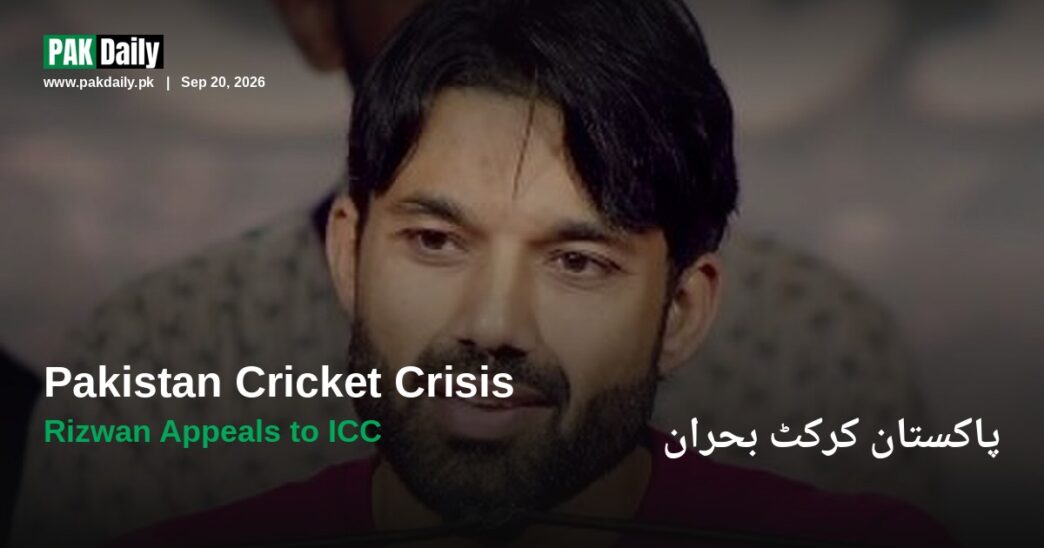
Pakistan cricket’s post-England meltdown has taken a new turn, with wicketkeeper-batter Mohammad Rizwan approaching the International Cricket Council’s Anti-Corruption Unit (ACU) directly, seeking clarity on how a domestic cyber-crime probe into his phone and finances is being handled — and whether it even falls within Pakistani agencies’ jurisdiction in the first place.
The move, first reported on September 19 by ProPakistani and separately confirmed by Business Standard, is the latest chapter in a crisis that began with Pakistan’s 3-0 Test series whitewash in England and has since spiralled into a national cyber-crime inquiry, a failed court challenge, and mounting questions about how the Pakistan Cricket Board (PCB) has handled its own players.
How We Got Here
- Early September: Pakistan lose the second Test to England at Lord’s by 194 runs, sealing a 3-0 series sweep — among the team’s worst results on English soil.
- September 8: The PCB sacks head coach Sarfraz Ahmed and bowling coach Umar Gul, and sends seven players home mid-tour, including Mohammad Rizwan, Imam-ul-Haq and Salman Ali Agha. Five uncapped players are flown in as replacements. High-performance director Aaqib Javed cites the coaching staff’s selection calls before the second Test as the reason. Captain Babar Azam later tells reporters, “It was news to me as well. I only found out about these things later,” distancing himself from the decision.
- Following the players’ return: The National Cyber Crime Investigation Agency (NCCIA) opens an inquiry described as concerning online betting and gambling, reportedly triggered by suspected information leaks from the team’s dressing room during the England series. Rizwan and Imam-ul-Haq are called in for questioning in Lahore; Rizwan’s phone is taken for forensic examination after an assurance it would be returned within three hours — a promise that, according to multiple reports, was not kept.
- Mid-September: The NCCIA issues Rizwan a five-page questionnaire seeking a decade of his social media activity, five years of income and bank records, property transactions, travel history and even household and children’s education expenses, according to ProPakistani.
- September 17: Rizwan petitions the Lahore High Court, arguing the NCCIA lacks jurisdiction and that any corruption-related inquiry should sit with the ICC’s Anti-Corruption Unit instead. The court dismisses the petition and directs him to cooperate and respond to the agency’s questionnaire.
- September 19: Rizwan files a request through the ICC ACU’s online portal, asking whether the seizure and forensic search of his phone — carried out after it was reportedly moved from the UK to Pakistan — complied with the ICC’s own Anti-Corruption Code, and seeking guidance on how he should cooperate with domestic investigators going forward.
Crucially, none of the reporting so far includes a specific, named allegation against Rizwan. The player has said investigators “failed to specify any concrete allegation or explain what illegal activity he was suspected of,” and no PCB or NCCIA official has publicly confirmed what triggered the probe beyond the general reference to “online betting and gambling” tied to alleged dressing-room leaks.
“He kept on insisting that he should be told about the charges or suspicions against him but didn’t get a clear answer,” Geo News reported, describing Rizwan’s exchange with investigators.
The PCB itself has stayed largely silent through the episode. As the Express Tribune noted in an editorial this week, the board has not clarified whether it formally suspects any player of wrongdoing or whether it notified the ICC’s anti-corruption unit as required, and that silence has allowed unverified match-fixing speculation to circulate in the media — speculation that, as of publication, remains just that: unconfirmed and unsubstantiated.
Rizwan, who has played more than 250 international matches for Pakistan with no prior corruption findings against him, remains part of the pool of contracted players despite being sent home from England. It is not yet clear when the NCCIA will conclude its inquiry or whether the ICC will formally weigh in on the jurisdiction question Rizwan has raised.
Our Opinion
A cricket board that sacks two coaches and sends seven players home mid-tour owes the public more than silence, and the PCB’s refusal to say plainly what it does or doesn’t suspect has done real damage — not just to Rizwan, a senior player with an unblemished record, but to the credibility of Pakistan cricket at a moment it can least afford it; if there is a genuine corruption concern, it belongs with the ICC’s Anti-Corruption Unit under a transparent process, and if there isn’t, the board should say so and let its players get back to preparing for the next series instead of fielding questions about a decade of social media history.