

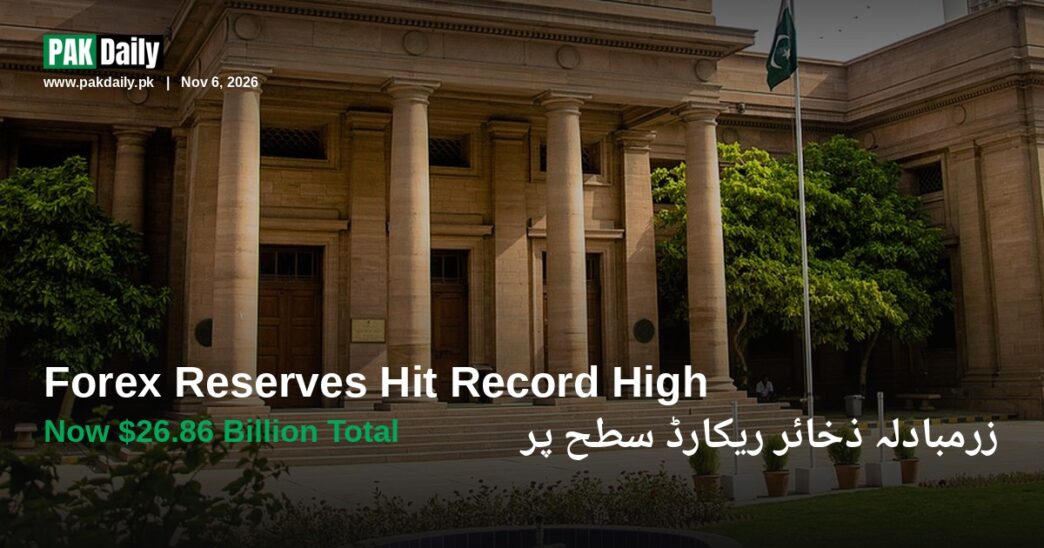
Pakistan’s total liquid foreign exchange reserves have climbed to an all-time high of $26.86 billion, the State Bank of Pakistan (SBP) reported this week, as the central bank continues building a cushion against the economic shocks of the ongoing Gulf war.
According to SBP data reported by Dawn, the country’s combined reserves — held jointly by the SBP and commercial banks — rose by $110 million in the week ending October 30, up from $26.754 billion the previous week. The central bank’s own reserves alone stood at $21.568 billion, up $39 million on the week, while commercial banks’ net reserves added $70 million to reach $5.303 billion.
| Reserve Component | Level (Oct 30, 2026) | Weekly Change |
|---|---|---|
| Total liquid reserves | $26.864 billion | +$110 million |
| SBP reserves | $21.568 billion | +$39 million |
| Commercial banks’ net reserves | $5.303 billion | +$70 million |
| SBP reserves (February 2026, for comparison) | $16.568 billion | — |
The scale of the build-up stands out against where things stood when the Gulf war broke out on February 28 this year, an event that rattled oil markets and weighed on several oil-importing economies, including Pakistan’s. Since then, the SBP’s own reserves have grown by more than $5 billion, even as the country continues to import the bulk of its energy needs.
Dawn reports that Pakistan’s financial sector views the SBP’s current reserve position as sufficient to keep the exchange rate stable, encourage exporters to repatriate their proceeds without delay, and give importers confidence in planning their dollar needs. That stability, however, is not without a cost. Currency experts cited in the report believe the rupee is currently overvalued, which lets importers buy dollars more cheaply than they otherwise would — a dynamic they say is widening the trade gap every month. Pakistan’s trade deficit for July-October of the current fiscal year has already reached $14.6 billion, with imports of $26 billion dwarfing exports of just $11.4 billion.
The reserve build-up also comes weeks after the SBP raised its policy rate by 50 basis points to 12 percent, a move the central bank linked directly to the risks posed by volatile global oil prices. Taken together, the two decisions point to a central bank leaning on higher reserves and tighter monetary policy at the same time to shield the economy from an external shock it does not control.
Our Opinion
A record reserve number is genuinely good news on its own terms, but it is worth asking what it is actually buying Pakistan — a stable exchange rate propped up this way is arguably papering over a widening trade deficit rather than fixing it, and the reliance on remittance inflows to plug that gap, without any real policy push to channel those inflows into investment rather than just balance-sheet padding, looks like a habit rather than a strategy; a few more months of headline-grabbing reserve totals should not be mistaken for the harder structural work of closing the gap between what the country imports and what it earns.