
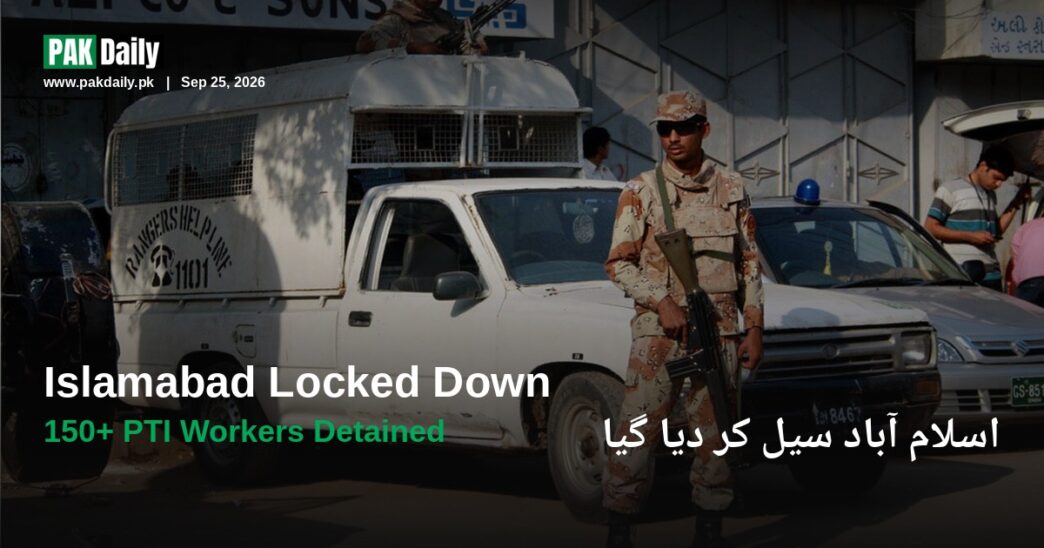
Islamabad and large parts of Punjab have been placed under some of the heaviest security measures Pakistan has seen this year, as the government moves to stop the Pakistan Tehreek-e-Insaf’s planned September 27 march on the capital demanding the release of party founder Imran Khan. Rangers have been deployed across the capital and four Punjab districts, Section 144 has been imposed in Islamabad for two full months, and more than 150 PTI leaders and workers have been detained in a single sweep through Rawalpindi division on Friday.
According to Dawn, the federal government authorised the Rangers’ deployment in the Islamabad Capital Territory and the Punjab districts of Rawalpindi, Attock, Jhelum and Mianwali under the Pakistan Rangers Ordinance, 1959, and the Anti-Terrorism Act, 1997, running from September 20 to October 5. The notification instructs the deployed troops that they “may respond appropriately in self-defence to any threats or violent activities encountered in the course of their duties.” Separately, more than 22,000 security personnel are being posted in Islamabad alone, a figure Dawn first reported and which was also picked up by wire-fed outlets including Kuwait Times.
Section 144 — which bans gatherings of five or more people — has been in force in Islamabad since September 18 for a full two months, according to The Express Tribune, under an order issued by Additional District Magistrate Dr Anam Fatima citing “reports indicating the likelihood of activities… that may adversely affect law and order, safety and security of public.” Anyone who violates it can face up to three years in prison under the Peaceful Assembly and Public Order Act, 2024. A parallel 13-day gathering ban covers all of Punjab from September 23 to October 5, while Karachi and Sukkur have Section 144 in force through September 30, Hyderabad through September 29, and Balochistan has banned gatherings of five or more people province-wide for 30 days.
| Security Measure | Detail |
|---|---|
| Rangers deployment | Islamabad Capital Territory + Rawalpindi, Attock, Jhelum, Mianwali; Sept 20–Oct 5, under the Rangers Ordinance 1959 and Anti-Terrorism Act 1997 |
| Section 144 — Islamabad | Bans gatherings of 5+ people; in force Sept 18 for two months; violation punishable by up to 3 years in prison |
| Section 144 — Punjab (province-wide) | 13-day ban on gatherings of 5+, Sept 23–Oct 5 |
| Section 144 — Karachi & Sukkur | In force through Sept 30 |
| Section 144 — Hyderabad | In force through Sept 29 |
| Section 144 — Balochistan | 30-day, province-wide ban on gatherings of 5+ |
| Security personnel — Islamabad | 22,000+ deployed |
| Security personnel — Rawalpindi division | 43,000+ police mobilised for march day |
| PTI detentions (Sept 25) | 150+ leaders/workers detained under MPO Section 3; ~10,600 police involved; reported target list of 463 names |
| Physical barriers | ~200,000 sandbags and ~110,000 tear-gas shells positioned in Islamabad; containers and trucks sealing key routes |
| Communications | Mobile and internet services expected to be degraded in Rawalpindi and Attock on Sept 27 |
On Friday, police in Rawalpindi division — which covers Attock, Chakwal, Jhelum, Rawalpindi and Murree — detained more than 150 PTI leaders and workers under Section 3 of the Maintenance of Public Order (MPO) Ordinance, with more than 10,600 police personnel involved in the operation and a reported target list running to 463 names, according to a report carried by IANS. The same law was used earlier this month to detain Imran Khan’s three sisters — Aleema Khan, Uzma Khan and Noreen Niazi — for 30 days each, a move PTI has repeatedly described as political victimisation.
“We have clearly told them that they can never achieve anything through such drama… they should not enter a dead-end street,” Interior Minister Mohsin Naqvi said, according to Dawn, adding that the party would not be allowed to “come to Islamabad and shut down the city for 10 days. That possibility does not exist.”
Naqvi has led the government’s public messaging on the march, saying the administration would rely on an existing Islamabad High Court order to disperse any gathering and would “not leave any loopholes” in its response if PTI went ahead.
Inside PTI, the march’s fate remains unsettled. Party lawyer Naeem Haider Panjutha suggested this week that the march could be delayed if the government agreed to hold fresh elections within six to eight months, released all political detainees — including Imran Khan — through the courts rather than a political deal, and ordered a judicial inquiry into the May 9, 2023 and November 26, 2024 crackdowns on the party. Within hours, PTI spokesperson Sheikh Waqas Akram rejected the idea, saying no such proposal was under discussion, that only Imran Khan could authorise a postponement, and that the march would go ahead as planned on September 27. PTI first announced the long march earlier this month.
Our Opinion
The sheer scale of this security build-up — two-month blanket bans, tens of thousands of personnel, and a detention list running into the hundreds — says as much about how entrenched Pakistan’s protest-and-crackdown cycle has become as it does about the specific threat this particular march is said to pose; and when a party’s own lawyer can float a negotiated postponement one day only for its spokesperson to publicly disown it the next, it suggests PTI itself has yet to settle whether confrontation or dialogue serves it better. Either way, pre-emptively detaining hundreds of workers who have not been individually accused of any crime sits uneasily with due process, and the government would strengthen its own case considerably by explaining, rather than simply asserting, why this march warrants measures well beyond what past protests in the capital have drawn.