
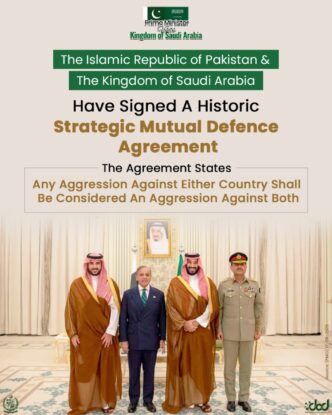

Riyadh, 17 September 2025 – Pakistan and Saudi Arabia have taken a big step by signing a Strategic Mutual Defence Agreement. Under this agreement, both countries have promised that if one of them is attacked, the other will treat it as an attack on both.
This deal is seen as a turning point for relations between the two nations and is expected to bring strong changes to security and politics in both South Asia and the Middle East. The agreement was signed in Riyadh by Pakistan’s Defence Minister Khawaja Muhammad Asif and Saudi Defence Minister Prince Khalid bin Salman.
Why This Agreement Matters
The agreement is important because it creates a joint defence system. It is similar to NATO’s Article 5, which says that an attack on one member is an attack on all. For Pakistan and Saudi Arabia, this means they will support each other in case of war or aggression.
Experts say this agreement changes the friendship between Pakistan and Saudi Arabia into a real defence alliance.
A Long History of Friendship
Pakistan and Saudi Arabia have always had close relations, but now it has reached a new level.
-
In the 1970s, Pakistan sent military trainers to Saudi Arabia to train its forces.
-
In the 1990s, during the Gulf War, Pakistan supported Saudi Arabia with logistics and advice.
-
In 2015, during the Yemen conflict, Pakistan did not send troops but continued to stay close to Saudi Arabia.
-
In 2025, both countries signed this defence agreement, making their cooperation official.
Talk About Nuclear Protection
After the signing, Pakistan’s Defence Minister Khawaja Asif said that if needed, Pakistan’s nuclear power could also act as a protection for Saudi Arabia.
This statement created big discussions worldwide. Western countries fear that nuclear weapons, which Pakistan developed mainly as a balance against India, may now be linked to the Middle East.
Saudi newspapers welcomed the idea and called it a “shield of protection” for the Muslim world.
Main Points of the Agreement
-
Mutual Defence – Any attack on one country will be treated as an attack on both.
-
Sharing Intelligence – Both sides will share information about terrorism, crime, and cyber threats.
-
Joint Military Exercises – Armies, navies, and air forces will train together more often.
-
Defence Industry Help – Pakistan’s defence factories will provide weapons, aircraft parts, and technical support to Saudi Arabia.
-
Naval Cooperation – Both will protect sea routes in the Arabian Sea and the Red Sea.
What It Means for the Region
India’s Concerns
India sees this agreement as a problem because it may give Pakistan more support and strength in the region.
Iran’s Concerns
Iran, which is often in rivalry with Saudi Arabia, is worried. Analysts believe Iran will now try to build even stronger ties with Russia and China.
The West’s Concerns
The United States and Europe have not given a strong response yet. But they are worried that Pakistan’s nuclear power being extended to Saudi Arabia may increase global nuclear risks.
Reaction Inside Pakistan
In Pakistan, many politicians and defence experts have welcomed the agreement. They believe it gives Pakistan a strong partner with big resources.
But some opposition leaders say Pakistan should focus on its own internal problems, like terrorism and militancy, instead of getting deeply involved in Middle Eastern conflicts.
Role for Other Arab Countries
Khawaja Asif also said, “The doors are not closed for other Arab nations.” This means countries like the UAE, Bahrain, or Egypt can also join the agreement in the future.
If that happens, the deal could become something like a “Muslim NATO”, where many Muslim countries protect each other under one system.
Safety Warnings
Soon after the deal, the Saudi embassy in Islamabad gave a security alert to its citizens, asking them not to go out unless necessary. This shows that both countries are already taking practical steps to improve safety.
What Experts Say
-
Dr Moeed Yusuf (former National Security Adviser, Pakistan): “This deal increases Pakistan’s importance in Middle Eastern security and makes it a central player.”
-
Abdulaziz Al-Shammari (Saudi defence analyst): “It is a strong message that Muslim countries can stand together for their defence.”
-
Western Think Tank (CSIS, Washington): “If Pakistan gives nuclear cover to Saudi Arabia, it will create serious concerns around the world.”
Final Thoughts
The Strategic Mutual Defence Agreement between Pakistan and Saudi Arabia is a historic step. It turns a long friendship into an official military alliance. It will affect not just the two countries but also the balance of power in South Asia and the Middle East.
Some experts see it as the first step towards a larger Muslim defence system. Others believe it may increase tensions with India, Iran, and even Western powers.
But one thing is clear: on 17 September 2025 in Riyadh, Pakistan and Saudi Arabia started a new chapter in defence and security cooperation that will shape the future of the region.
The agreement lands the same month a Pakistani delegation joined an international flotilla attempting to deliver aid to Gaza — both stories reflect Pakistan’s more visible foreign-policy posture this year.
Our Opinion
A mutual defense agreement of this scope is a major strategic commitment, and Khawaja Asif’s suggestion that Pakistan’s nuclear capability could extend to Saudi Arabia’s protection is the kind of statement that carries consequences well beyond a single interview — nonproliferation credibility is not something any nuclear state can walk back easily once floated. The opposition’s point, that Pakistan’s own internal security challenges deserve at least equal attention to new regional commitments, is reasonable regardless of how the broader alliance develops, and how transparently the government explains the practical scope of the nuclear-related remarks will matter more to Pakistan’s international standing than the headline signing itself.