
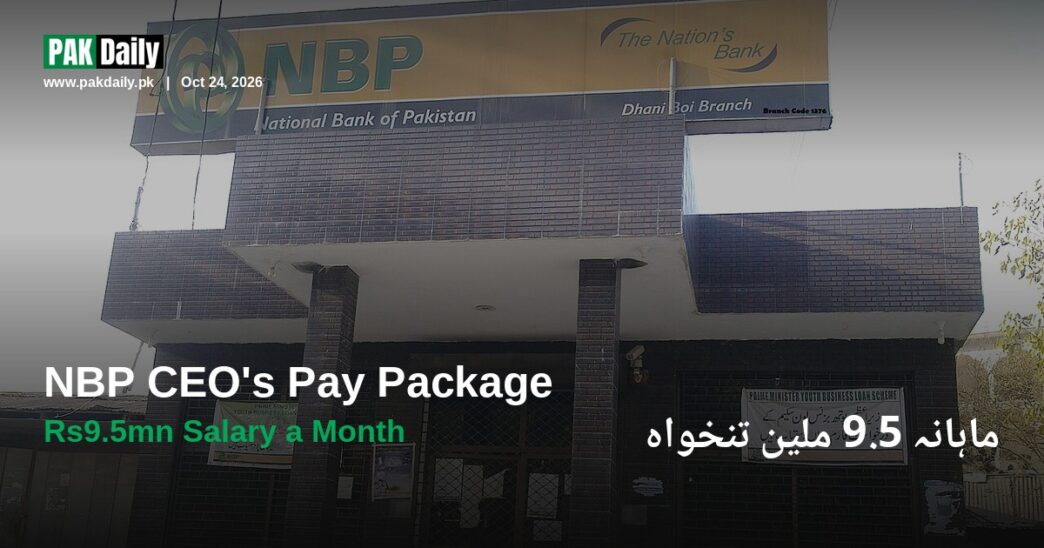
The National Bank of Pakistan (NBP) has disclosed a lucrative pay package for its newly appointed President and CEO, Imran Sarwar, that includes a monthly salary of Rs9.5 million, a Rs30 million life insurance policy, two company cars, and a security detail of four armed guards. The terms were revealed in a filing to the Pakistan Stock Exchange (PSX) on Friday, according to Business Recorder, which reviewed the full compensation structure approved by the bank’s shareholders.
Sarwar took charge of NBP, one of Pakistan’s largest state-owned commercial banks, on September 9, 2026, for an initial three-year term. His package was approved under Section 11(3)(a) of the Banks (Nationalization) Act, 1974, the law that governs executive pay at state-run banks, and goes well beyond the base salary figure to cover housing, transport, domestic staff, medical care, and retirement benefits.
What’s in the Package
Business Recorder’s review of the PSX filing lays out the full structure in detail. Here is how it breaks down:
| Component | Details |
|---|---|
| Gross Salary | Rs9.5 million/month, plus a variable annual bonus tied to board-assessed KPIs |
| Housing | Rs1 million/month house rent allowance |
| Vehicles | Two cars (one up to 3,500cc, buyable at contract end for 10% of cost or written-down value, whichever is higher, plus a bank pool car); two drivers or Rs45,000/driver/month in lieu |
| Security & Household Staff | Four armed guards on 12-hour shifts at his residence; Rs150,000/month for five domestic staff |
| Leave | 30 annual + 18 casual/sick days a year; unused annual leave accumulates up to 90 days, encashable at last-drawn gross salary |
| Generator | Up to Rs1.5 million, amortised over his tenure |
| Medical | Full coverage for himself and dependents in Pakistan |
| Life Insurance | Rs30 million cover, with premiums split 50/50 between Sarwar and the bank |
| Gratuity | One month’s last-drawn gross salary for every year of service |
| Club Memberships | Entry fees covered for two clubs, plus subscriptions for three |
| Exit Terms | Paid out for the remaining term if NBP terminates him early; three months of “gardening leave” if he resigns |
Who Is Imran Sarwar
Sarwar brings more than 36 years of banking experience to the role. Before joining NBP, he served as Group Executive for Risk and Credit Policy and as Chief Risk Officer at United Bank Limited, and earlier held the post of Managing Director and Head of Corporate Banking for the UAE at Standard Chartered, according to a profile published by ProPakistani when his appointment was first announced in September. He has also served on the boards of Khushhali Microfinance Bank and the Pakistan Mortgage Refinance Company.
Why It’s Drawing Scrutiny
The scale of the package has stirred debate online since the filing became public, with critics pointing to the gap between a state bank chief’s compensation and the economic pressure facing most Pakistanis. NBP is majority state-owned, with the federal government holding a controlling stake through various state entities, which means executive pay decisions there carry more public weight than at a purely private bank. The compensation structure itself is not unusual by the standards of large commercial banks, where multi-million-rupee packages, vehicle allowances and security provisions for top executives are common; what has drawn attention here is the level of detail made public through the PSX disclosure, down to driver cash allowances and club subscriptions, at an institution whose majority owner is the state.
Our Opinion
There is nothing improper about a major bank compensating its chief executive competitively, and Sarwar’s three-decade career in risk and corporate banking is a legitimate basis for a senior package; the real question is less about one executive’s pay and more about why state-owned financial institutions in Pakistan continue to approve this level of detail in perks, from armed security to club memberships, with so little public explanation of the performance benchmarks attached to the KPI-linked bonus, especially at a time when the government is still leaning on austerity messaging to justify tax hikes and subsidy cuts elsewhere in the economy; if NBP wants this kind of disclosure to build public trust rather than erode it, the next useful step would be publishing the actual KPIs the board will use to judge Sarwar’s bonus, not just the numbers attached to his base pay.