
Pakistan Petroleum Limited (PPL), the country’s largest state-run exploration and production company, posted one of its strongest annual results on record for the year ended June 30, 2026, shareholders were told at the company’s 75th Annual General Meeting held in Karachi on Tuesday, October 27.
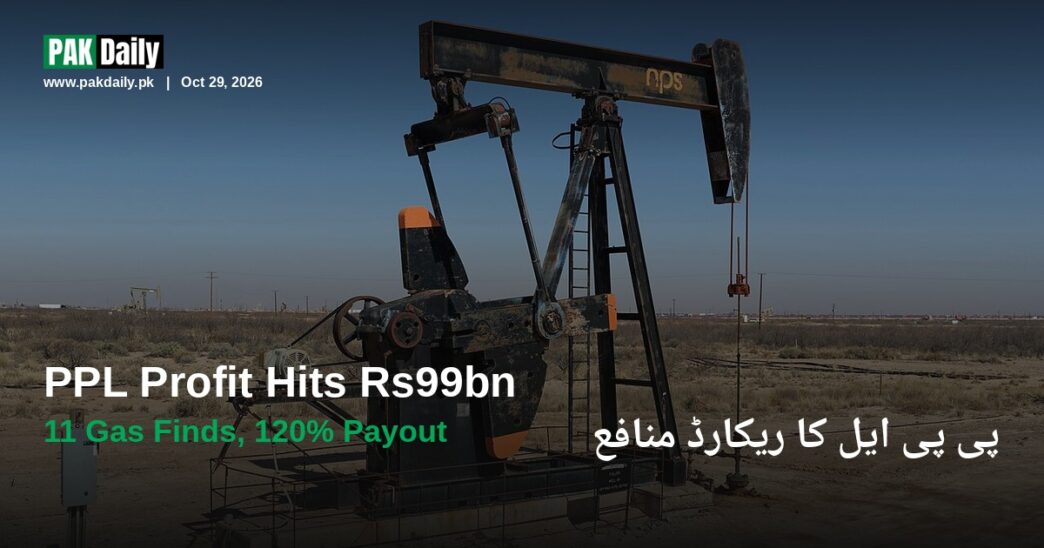
According to Dawn’s report on the AGM, PPL earned a profit after tax of Rs99 billion for FY26, with total collections touching Rs284 billion over the year. The company’s own regulatory filing with the Pakistan Stock Exchange (PSX), however, lists consolidated profit after tax at Rs97.68 billion for the same period — a gap of roughly Rs1.3 billion, or about 1.3 percent, between the two figures. Neither source explains the difference directly, so it is likely a rounding or standalone-versus-consolidated reporting variation rather than a factual dispute, but readers should note both numbers exist in the public record.
Average daily production held up at 649 million cubic feet per day (mmcfd), nearly 3 percent higher than the previous year, even as the company continued to face periodic gas curtailment on its network — a sign, analysts say, of the Sui gas fields operator squeezing more output from its mature assets while newer discoveries are still being developed.
| Metric | FY26 | FY25 |
|---|---|---|
| Profit after tax (PSX filing, consolidated) | Rs97.68 billion | Rs89.95 billion |
| Profit after tax (as reported at AGM, per Dawn) | Rs99 billion | — |
| Earnings per share | Rs35.90 | Rs33.06 |
| Total collections | Rs284 billion | — |
| Average daily production | 649 mmcfd | ~630 mmcfd (approx. 3% lower) |
| Final cash dividend | Rs6.00/share (60%) | — |
| Total dividend for the year | 120% | — |
The AGM also approved a final cash dividend of Rs6 per share, or 60 percent, which combined with interim payouts already made during the year brings PPL’s total dividend for FY26 to 120 percent — a payout size that will be closely watched by income-focused investors on a stock exchange that has been volatile in recent weeks.
On the exploration side, the company reported drilling 7 exploration wells and 4 development wells during the year, which combined with its partners’ activity led to 11 new discoveries — 2 on PPL-operated acreage and 9 on blocks operated by its partners. Together, these finds added an estimated 242 billion cubic feet (BCF) to the company’s proven-plus-probable (2P) reserves, a figure that matters for a country still heavily reliant on imported LNG to plug its gas supply gap.
- 11 new hydrocarbon discoveries across PPL-operated and partner-operated blocks
- 242 BCF added to 2P reserves
- 7 exploration wells and 4 development wells drilled during FY26
- Average production up roughly 3% year-on-year despite curtailment
The results land just days after PPL shares were caught up in a broader market selloff — the stock was among the heaviest drags on the PSX when the benchmark index dropped 1,549 points on October 23 amid Middle East tensions. A strong earnings season for the oil and gas sector could help steady sentiment around energy stocks heading into November, though PPL’s share price reaction to the AGM announcement itself was not immediately reflected in the available coverage.
Our Opinion
A near-record profit and a 120 percent dividend are genuinely good news for PPL’s shareholders and for a state-run energy sector that Pakistan badly needs to see performing well, but the unexplained roughly Rs1.3 billion gap between what was announced at the AGM and what the company itself filed with the stock exchange is the kind of small inconsistency that erodes investor trust over time if it becomes a pattern; a one-line reconciliation note in PPL’s next investor briefing would cost the company nothing and would matter more than the headline number itself. The 11 new discoveries are the more consequential story in the long run — reserve additions, not a single year’s profit swing, are what will determine whether Pakistan can meaningfully reduce its dependence on imported gas over the next decade, and that progress deserves to be tracked as closely as the dividend headline that tends to grab the attention.