

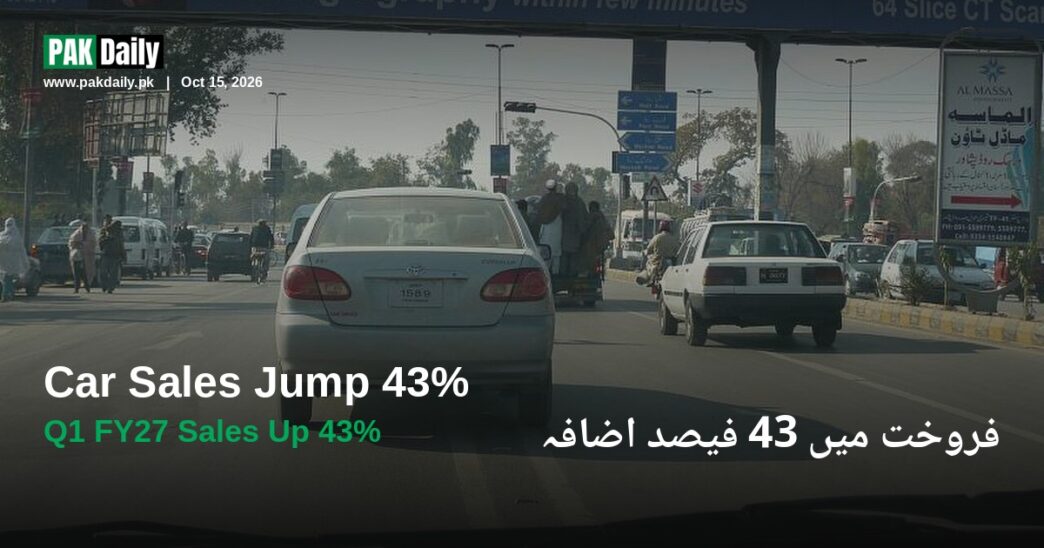
Pakistan’s car market is finally showing signs of life. New figures released by the Pakistan Automotive Manufacturers Association (PAMA) show passenger car sales jumped 43 percent year-on-year in the first quarter of FY2026-27 (July-September 2026), climbing to 41,872 units, Business Recorder reported, with Geo News independently confirming the same 43 percent growth figure and putting car production up 32 percent over the same period.
The rebound, PAMA Director General Razi-ur-Rahman said, is being driven by easing inflation and a steadier macroeconomic backdrop rather than any new policy push from the government — in fact, he pointed to the opposite problem. Buyers and manufacturers alike are growing increasingly uneasy about an auto policy that still hasn’t been finalised.
“This renewed sales momentum is on the back of easing of inflationary pressures and an improving macroeconomic environment,” Razi-ur-Rahman said, before adding a word of caution: “While overall industry volumes are steadily recovering, there is perceptible hesitation on part of the players in the market,” a reference to the lack of clarity on the pending auto policy that he said “continues to dominate the market sentiment.”
The growth wasn’t even across the industry. While passenger cars and farm tractors posted strong gains, the picture was mixed elsewhere — jeeps and pickups actually fell, even as heavier commercial vehicles grew. Here’s how each segment performed in Q1 FY2026-27, per PAMA data carried by Business Recorder:
| Vehicle Category | Units Sold (Q1 FY27) | YoY Change |
|---|---|---|
| Passenger Cars | 41,872 | +43% |
| Jeeps & Pickups | 8,608 | -34% |
| Trucks | 2,516 | +53% |
| Buses | 211 | -5% |
| Farm Tractors | 4,109 | +38% |
| Two & Three-Wheelers | 553,994 | +28% |
Geo News, citing the same PAMA dataset, grouped trucks and buses together and reported combined sales up 46 percent with production up 54 percent — broadly in line with Business Recorder’s separated figures above, since combining a 53 percent truck gain with a smaller bus segment that dipped 5 percent lands in roughly the same range. The two outlets also diverged on how hard September alone was hit: Business Recorder put September car sales at 10,939 units, down almost 10 percent from 12,126 units a year earlier, while Geo framed the same month as a 20 percent month-on-month fall from August. Both can be true at once — they’re simply measuring the dip against different baselines — but it’s worth flagging that the exact size of September’s slowdown depends on which comparison you use.
That September softness showed up unevenly at the company level too. According to Topline Research data cited by Geo News, Pak Suzuki had the roughest month, with sales down 46 percent year-on-year to 4,862 units, while Honda Atlas slipped 8 percent to 2,128 units and Hyundai Nishat fell 25 percent to 884 units. Indus Motor, which assembles Toyota models, bucked the trend with a 31 percent rise to 4,142 units.
| Assembler | September 2026 Units | YoY Change |
|---|---|---|
| Indus Motor (Toyota) | 4,142 | +31% |
| Honda Atlas | 2,128 | -8% |
| Pak Suzuki | 4,862 | -46% |
| Hyundai Nishat | 884 | -25% |
Geo News reported that Haroon Akhtar Khan, the prime minister’s adviser on industries and production, told a Senate committee earlier this month that the new auto policy would be approved “within two weeks.” Topline Securities analyst Sania Irfan linked some of the recent softness to delayed clarity on sales-tax treatment for hybrid and plug-in hybrid vehicles — an issue PakDaily covered when the general sales tax on hybrids was cut to 18 percent earlier this year — and still forecasts double-digit sales growth for the full fiscal year despite the uncertainty.
Our Opinion
A 43 percent jump in car sales is a genuinely encouraging number for an industry that spent much of the last few years in a slump, but PAMA’s own statement is really a warning dressed up as good news; an industry that depends on buyers timing their purchases around tax and tariff rules can’t plan investment, pricing, or production around a policy that keeps getting promised “within two weeks” without ever quite arriving. The government would do well to treat this recovery as a window to lock in predictable rules rather than a reason to keep deferring them, because the same hesitation PAMA describes among manufacturers can just as easily show up among buyers if the uncertainty drags on much longer.