
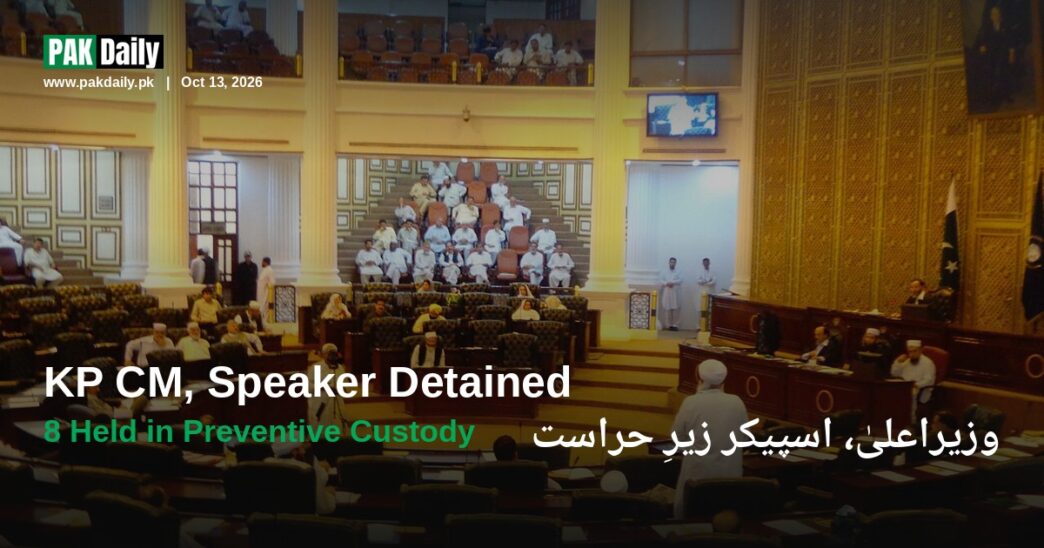
Eight people, including Khyber Pakhtunkhwa’s suspended chief minister Sohail Afridi and provincial assembly speaker Babar Saleem Swati, were taken into “preventive custody” on the night of October 11, hours after the federal government imposed emergency and governor’s rule across the province, according to Dawn and The Express Tribune.
A senior police official told Dawn that eight people in total were detained, though only three were named: Afridi, Swati, and PTI MNA Junaid Akbar. The Tribune separately confirmed the same headline figure, reporting that police described the suspended chief minister and speaker as being “in preventive custody,” with Akbar “among eight held.”
Federal Minister of State for Interior Tallal Chaudhry told Reuters the detentions were precautionary rather than punitive:
“[They] have been taken into preventive custody,” Chaudhry said, adding that anyone with pending criminal cases would be formally charged and tried, while the rest would be released once the situation settled.
Sources told Dawn that Afridi and Akbar were being held under Section 3 of the Maintenance of Public Order (MPO) ordinance, which allows preventive detention without a formal charge, though this was not officially confirmed by authorities.
The arrests came at the end of a fast-moving sequence of events:
- Talks between the federal government and PTI over counterterrorism policy in Khyber Pakhtunkhwa broke down on October 3.
- The Centre moved to impose emergency and governor’s rule in the province under Articles 232 and 234 of the Constitution, approved by the president on October 11.
- Governor Faisal Karim Kundi took charge of day-to-day administration, backed by an 11-member technocratic KP Advisory Council, and said his top priority was “taking effective steps against terrorism.”
- The federal government separately authorised Pakistan Army troops to assist civil authorities in the province.
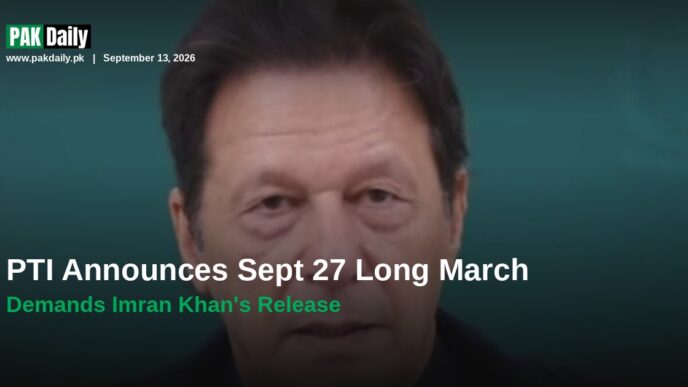
- Hours later, police took Afridi, Swati, Akbar, and five others into preventive custody as a PTI long march led by Afridi headed toward Islamabad.
PTI has rejected the government’s justification. Spokesperson Sheikh Waqas Akram said the detentions “exposed the political nature of the federal government’s actions,” arguing the measures were designed to weaken PTI and undermine an elected provincial government rather than address security concerns. The party has vowed to continue its planned protest despite the crackdown, and residents in Peshawar reported shipping containers blocking roads, heavy police deployment, and intermittent mobile and internet disruptions in the hours before the detentions.
This is the fourth time governor’s rule has been imposed on Khyber Pakhtunkhwa, underscoring how often the province has been governed directly from the centre during periods of political confrontation. The move follows weeks of a deepening standoff between Islamabad and PTI, which has also included efforts by JUI-F chief Maulana Fazlur Rehman to mediate the deadlock between the two sides.
Deputy Prime Minister Ishaq Dar has defended the emergency and governor’s rule as a necessary response to a deteriorating security situation, saying the government “had little choice,” while opposition figures, including PPP chairman Bilawal Bhutto Zardari, have separately warned that the move risks further inflaming an already volatile political standoff.
Our Opinion
Governor’s rule being invoked for a fourth time in Khyber Pakhtunkhwa says less about any single government and more about a provincial administration that keeps getting pulled into Islamabad’s hands whenever a political crisis peaks; whatever the security justification offered this time, preventively detaining an elected chief minister, an assembly speaker, and a sitting MNA without formal charges is the kind of measure that should be used sparingly and reviewed quickly, not treated as a routine tool of political management — and the coming days, particularly whether the detainees are released as promised and whether the Advisory Council’s counterterrorism steps produce real results, will say more about this episode’s intent than any of the statements issued so far.