
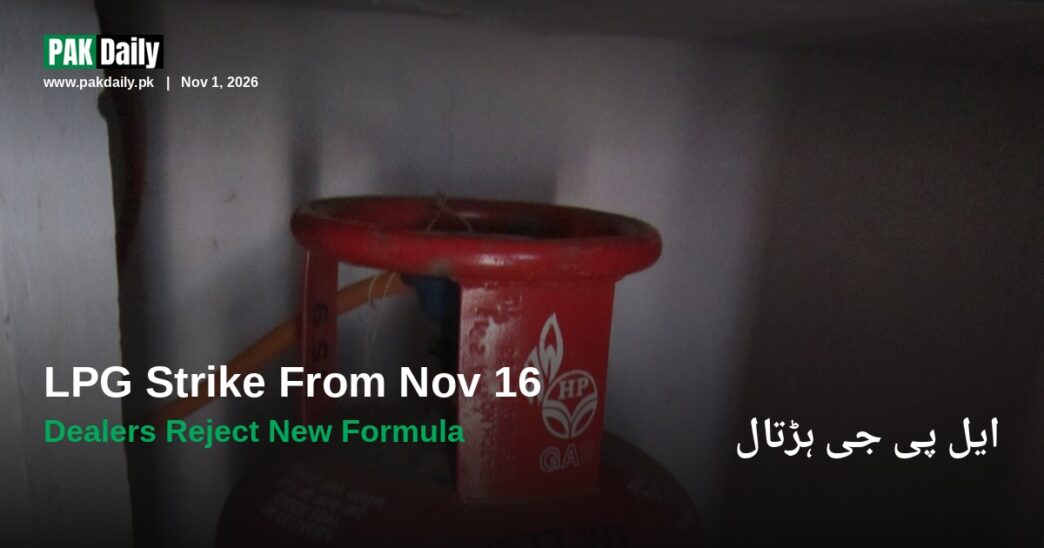
Pakistan’s LPG trade has thrown down the gauntlet. The Pakistan LPG Marketers Association, along with allied dealer bodies, announced on Saturday that they will shut down LPG sales and business nationwide from November 16 unless the government withdraws a new pricing formula they say will push gas prices up by another 25 to 30 percent. The announcement came after an emergency meeting of LPG associations held in Karachi.
Ali Haider, senior vice-chairman of the Pakistan LPG Marketers Association, told reporters that bureaucrats have proposed benchmarking LPG prices nationwide to the rate of sea-imported LPG. He called the idea impractical, pointing out that roughly 90 percent of LPG in Pakistan is moved overland by road tankers, not by sea. Pegging the whole country’s price to an import-based benchmark, he said, would also unfairly inflate the cost of the nearly 30 percent of supply that is produced domestically.
Traders are separately objecting to a Ministry of Energy proposal to shift LPG price-setting away from the Oil and Gas Regulatory Authority (OGRA) to state-owned companies, which they argue would weaken market transparency, reduce free competition, and hurt consumer rights, according to Business Recorder.
“If the government does not accept our demands within 15 days, LPG supply and business activity will be suspended across the entire country,” Haider warned, as quoted by ARY News.
The dispute lands at a time when the gap between official and street prices is already wide. OGRA’s notified rate for November 1 puts LPG at Rs294.75 per kg, with an 11.8kg domestic cylinder priced at Rs3,470. In the open market, however, dealers in Karachi and other major cities are charging Rs500 to Rs550 per kg, while rates in remote areas climb to Rs630-800 per kg — pushing an 11.6kg cylinder as high as Rs7,000 in some places, according to Daily Pakistan.
| Category | Official (OGRA) Rate | Open Market Rate |
|---|---|---|
| Per kg | Rs294.75 | Rs500 – Rs800 |
| Domestic cylinder (11.6–11.8 kg) | Rs3,470 | Up to Rs7,000 |
| Urban centres (Karachi, etc.) | — | Rs500 – Rs550/kg |
| Remote areas | — | Rs630 – Rs800/kg |
Part of the squeeze is seasonal and part of it is geopolitical. Daily LPG demand typically runs at 4,000 to 4,500 tonnes but is expected to jump to 6,000-7,000 tonnes as winter sets in — a roughly 50 percent increase that always strains supply. On top of that, the Iran-US standoff has disrupted overland LPG trade across the Pakistan-Iran border, while supplies from Qatar have also been suspended, tightening the market further and adding to rural inflation, Daily Pakistan reported.
Industry bodies say the combination of a shortage-driven price gap and a formula that could push official rates even higher risks making the fuel — widely used for cooking and heating in areas without piped gas — unaffordable for ordinary households just as winter demand peaks.
- Nationwide LPG strike announced for November 16, 2026
- Government given a 15-day deadline to withdraw the new pricing formula
- Associations also oppose shifting price-setting from OGRA to state-owned firms
- Open-market cylinder prices already running up to double the official rate
Business Recorder, ARY News, Samaa TV, and Daily Pakistan all reported the strike announcement and the November 16 deadline; no response from OGRA or the Ministry of Energy had been reported by the time of publication.
Our Opinion
This standoff is really about who gets to set the price of a fuel that millions of households without piped gas depend on to cook their food — and the dealers have a point when they call a single sea-import benchmark impractical for a market that moves 90 percent of its product by road. But the louder signal here is structural: the official rate and the street rate have drifted so far apart that OGRA’s own notification is starting to look like a formality rather than a real price, and that gap is where hoarding, profiteering, and now strike threats all take root. Whatever the government decides on the formula, the bigger fix PakDaily would watch for is whether anyone addresses the Iran border disruption and the Qatar supply gap that are doing as much to inflate prices as any formula on paper — because a strike that ends in a compromise on pricing mechanics will still leave Pakistani households paying import-crisis prices for a domestically available fuel.