

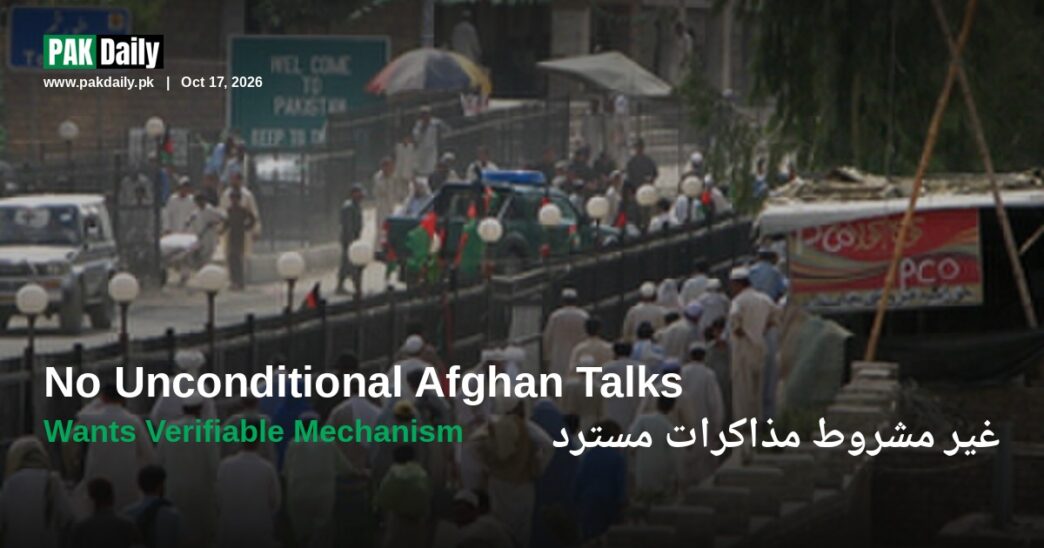
Pakistan said on Friday that it remains open to dialogue with Afghanistan but will not agree to unconditional talks, as tensions over cross-border militancy continue to simmer between the two neighbours. Addressing the weekly Foreign Office briefing in Islamabad, spokesperson Sajjad Haider Khan said Pakistan would welcome sincere assistance from friendly countries in resolving the dispute, according to Dawn, but made clear that any process has to be built on substance rather than good intentions alone.
“The talks will not be unconditional,” Khan told reporters, reiterating that Islamabad wants a verifiable mechanism to end terrorist attacks launched from Afghan soil before any formal process can move forward.
It is a familiar Pakistani position, but one that keeps resurfacing because mediation attempts keep falling short. Over the past year, at least four separate efforts to bridge the gap between Islamabad and Kabul have failed to produce a lasting breakthrough:
- October 2025: Qatar and Türkiye brokered a ceasefire in Doha after the worst Pakistan-Afghanistan border clashes in years, but follow-up talks did not produce a durable settlement.
- Late 2025: Saudi Arabia separately hosted rounds of discussion between the two sides, again without a breakthrough on the core dispute.
- April 2026: China hosted a further round of talks in Urumqi, which likewise failed to resolve the standoff over alleged militant safe havens.
- October 5, 2026: Pakistan and Afghanistan failed to agree on a joint statement at Moscow Format consultations, splitting over language describing terrorist networks operating from Afghan territory. Khan said Kabul rejected wording it had accepted the previous year, calling it a sign of reluctance to acknowledge that terrorism originates from Afghan soil.
Russia, the only country to have formally recognised the Taliban government, has separately offered to mediate between Islamabad and Kabul if both sides request it, an offer floated earlier this month by special envoy Zamir Kabulov. Asked about it at Friday’s briefing, Khan said he was not aware of any formal Russian mediation initiative currently under discussion.
On the substance of the dispute, Khan said the Afghan Taliban administration has yet to take a clear position on the Tehreek-e-Taliban Pakistan (TTP) and other militant groups it is accused of sheltering, and continues to reject Islamabad’s claim that Afghan soil is being used to stage attacks inside Pakistan. He described Kabul’s approach as taking “one step forward and one step backward.”
The briefing also touched on a fresh warning from India. A day earlier, Indian Defence Minister Rajnath Singh, speaking at the National Defence Conclave 2026 in New Delhi, threatened a bigger strike after any future terrorist attack and invoked last year’s Operation Sindoor. Khan dismissed the remarks as provocative, saying any future Indian aggression would be met with a stronger response than Pakistan’s answer to India’s military action in May 2025, and urged New Delhi to abandon what he called a belligerent posture.
Our Opinion
Four attempted mediations in under a year — Doha, Saudi Arabia, Urumqi, and now a failed Moscow round — suggest a dispute that outside brokers alone cannot settle, since the real gap between Islamabad and Kabul is not about who sits at the table but about whether Afghanistan will act against groups it has so far mostly managed rather than dismantled; layering India’s renewed sabre-rattling on top of that stalemate risks making an already difficult western border harder to secure at a moment Pakistan can ill afford a two-front security headache, and the more productive path for both capitals is probably quieter, technical border-security cooperation rather than another round of talks staged mainly for the cameras.