
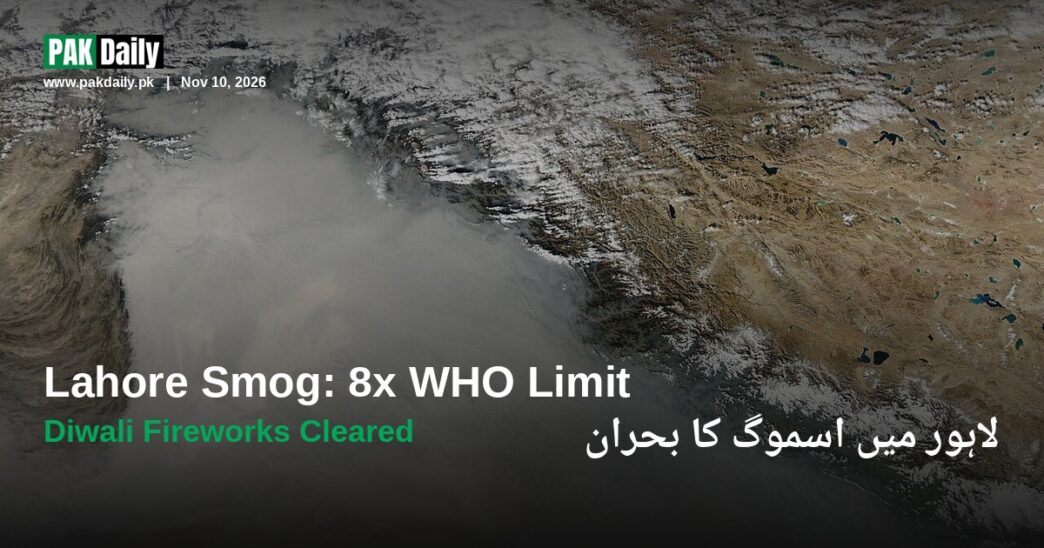
Lahore’s air was roughly eight times dirtier than World Health Organisation safety guidelines over the past six weeks, according to a new report from the Pakistan Air Quality Initiative (PAQI) cited by Dawn on Tuesday. The report also pushes back on a popular theory doing the rounds this week — that smoke drifting in from Diwali fireworks across the border in India is driving Lahore’s latest smog spike.
PAQI’s analysis found Lahore’s average PM2.5 concentration sat at 126 micrograms per cubic metre (µg/m³) between October 1 and November 9 — about eight times the WHO’s guideline level, and enough to breach Pakistan’s own 24-hour National Environmental Quality Standards on all 40 days for which valid readings were available. There was a silver lining buried in the data: this year’s average was 11% lower than the same six-week stretch in 2025, suggesting the city’s air, while still hazardous, has not gotten uniformly worse.
The bigger story in the report is how closely Lahore’s pollution tracks with crop-residue burning across Punjab. Satellites detected 18,825 fires between October 1 and November 9, with 89% of them — 16,714 fires — classified as likely crop-stubble burning rather than wildfires or other sources. The single worst day was November 1, when 1,102 fires were detected in one go. Five districts accounted for more than half of all the fire activity: Sheikhupura (2,559 detections), Jhang (2,192), Okara (2,062), Hafizabad (1,893) and Gujranwala (1,417).
On days when wind patterns carried smoke from those burning areas into cities, the difference was stark, per the PAQI figures:
| City | PM2.5 on fire-affected days (µg/m³) | PM2.5 on other days (µg/m³) |
|---|---|---|
| Lahore | 175 | 93 |
| Multan | 203 | 88 |
| Bahawalpur | 125 | 65 |
PAQI’s own report cautions that this correlation does not prove exactly how much of the urban smog comes from crop burning specifically, since still, stagnant winter weather that traps pollutants close to the ground is also a major factor. The group projects 642, 668 and 617 upwind fires for November 10, 11 and 12 respectively, meaning the fire count isn’t expected to ease immediately.
The Diwali Fireworks Theory, Tested and Rejected
With Diwali falling earlier this week, a familiar seasonal theory resurfaced on social media: that fireworks smoke from India is blowing across the border and choking Lahore. PAQI tried to actually test that claim using back-trajectory modelling, and the report concludes the evidence doesn’t support it. Here’s what the group found, in sequence:
- PAQI traced 48 separate back-trajectories of air arriving in Lahore, Kasur and Sialkot between 9pm on November 8 and midnight on November 10. Of those, 45 had indeed passed over Indian territory within the prior 12 hours.
- Despite that, the timing and geography didn’t line up with a Diwali-smoke explanation. Lahore’s average PM2.5 in that window (234 µg/m³) was only about 10% above the preceding seven days — a rise, but not the dramatic spike a direct fireworks plume would suggest.
- The city-by-city pattern cuts against a simple cross-border story too: Kasur rose 27% and Sialkot 33% in the same period, but Narowal — also near the border — actually fell 2%, while Faisalabad and Multan, both much further from India, rose 40% each.
- Air that had passed over New Delhi only reached Pakistani territory after 3am on November 10, near Rahim Yar Khan and Bahawalpur, and stayed as far as 266 kilometres from Lahore — too far away, geographically, to have been the main driver of Lahore’s own spike.
PAQI notes that definitively separating fireworks smoke from crop-residue smoke would require chemical analysis for markers like potassium, strontium and barium, which Pakistani monitoring stations don’t currently carry out. In a report released on November 8, PAQI and the Punjab government’s Environment Protection and Climate Change Department (EPCCD) had themselves flagged 2,347 crop-residue burning incidents in Indian Punjab and warned Diwali smoke could reach Lahore within 5 to 13 hours — so the cross-border smoke did arrive, by the group’s own telling, it just doesn’t appear to be the dominant factor in this week’s readings.
Punjab Government Points to a Monday Improvement
The EPCCD, for its part, highlighted a sharp single-day improvement. The department said Lahore’s average Air Quality Index (AQI) fell from 489 at 9am on Monday to 232 by 3pm the same day — a drop of about 53% — with all 11 monitoring stations in the city recording declines. The Egerton Road station reportedly fell from 500 to 167, and the GT Road station from 500 to 172. The department credited anti-smog guns and mist-sprinkling operations deployed across roughly 640 kilometres of city routes.
EPA Director General Abdullah Nayyar Sheikh said the department had adopted “a zero-tolerance approach towards major sources of air pollution,” according to Dawn.
Those single-day AQI swings are worth reading with a bit of caution, since they’re self-reported by the same department that is also the one being judged on its anti-smog performance this season — a pattern Dawn itself has flagged in past coverage of Punjab’s stubble-burning claims. Separately, the Provincial Disaster Management Authority has forecast rain across most Punjab districts, including Lahore, over the next two days, which should help clear the air in the short term, if colder weather in exchange.
Our Opinion
What stands out about this report isn’t the headline pollution number — Lahore residents have lived through numbers like this for years — it’s that an independent initiative actually went and tested a popular public theory instead of letting it sit unexamined on social media, and found it didn’t hold up; that’s the kind of accountability Punjab’s own environment department rarely applies to its own claims of single-day AQI improvements. A 53% afternoon drop measured by the agency responsible for managing the crisis, with no independent party checking the number, deserves the same scrutiny PAQI applied to the Diwali theory, not a free pass just because the direction is good news. Until crop-residue burning in both Punjab’s own districts and across the border is tackled at the source rather than managed with anti-smog guns on the worst days, Lahore’s winters will keep producing headlines like this one, rain or no rain.